
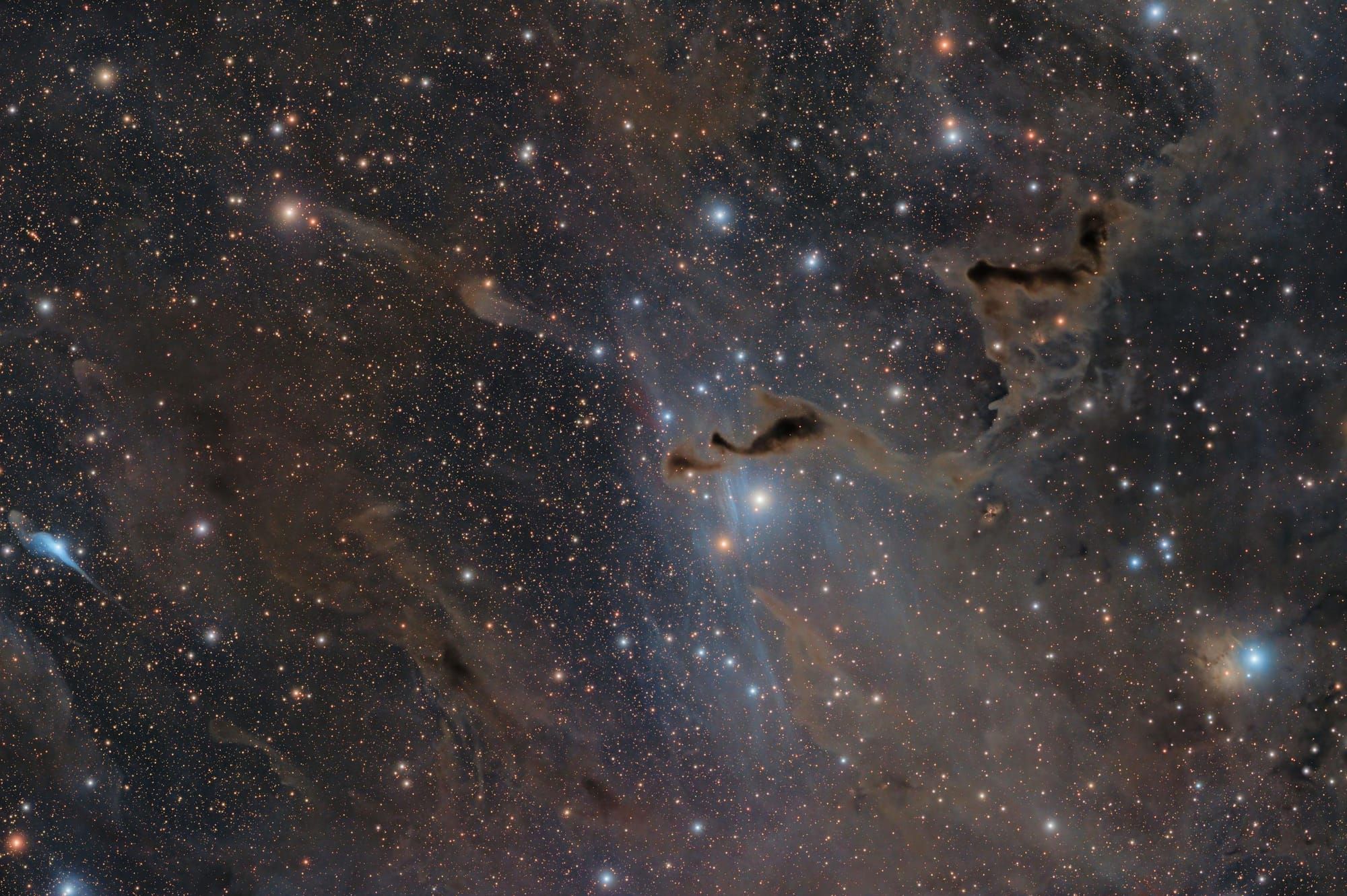
I set down this account not in any hope of being believed, but because the frames themselves will outlast me, and someone ought to know what they are looking at. For sixteen hours across many nights I turned my instrument toward that obscure corner of Cassiopeia where, beside the modest glow the catalogs call vdB 8, there spreads a thing no cataloger ever troubled to name aright. The dark cloud there is listed merely as LDN 1357, one of eighteen hundred and two such voids that a patient astronomer charted from the Palomar survey plates in 1962: a number, and nothing more. Numbers are a mercy. They spare us from looking too long.
Against that blackness lies a pale, luminous smear which I can describe only as an alien translucent gel, spread across the stars as though something vast had dragged its palm through them. Amateurs have given the dark shape a cheerful nickname, the Helping Hand, for its outstretched fingers of dust. I no longer find it cheerful.
The gel is lit, the catalogs say, by the star SU Cassiopeiae, and it was in reading of that star that my unease first curdled into dread. SU Cas is a Cepheid. It swells and shrinks, brightens and fades, on a rhythm of one day and nearly twenty-three hours, regular as a heart. Worse, the learned papers report that it does not even beat in its natural mode, but in an overtone, a higher and quicker harmonic, like a voice singing above its proper register. And the scholars, with the bland caution of their kind, allow that the physical connection between the star and the glowing stuff beside it is uncertain. Uncertain! As though the star merely happened to lie there. As though the gel merely happened to glow.
I compared my earliest frames against my last. I tell myself the differences are noise, flats, the clumsy arithmetic of stacking. I tell myself the smear cannot have crept a hair's breadth toward the dark fingers in a few weeks, since nothing so vast could move so quickly. Reason says this. Reason has always said this, right up to the moment it stops being consulted.
Last night I did not image. I sat beneath the open roof and counted, as a man counts the seconds after lightning, the hours since the star's last brightening. It came precisely on schedule, as it always does. And there in the dark, with the camera cooling beside me, I understood at last that a heart which beats so steadily must be pumping something, and that the hand was never open in greeting. It is closing.
Top Pick
16h
Sep 18, 2023
Lum: 8h (48 × 600″)
Red: 2h 40m (16 × 600″)
Green: 2h 40m (16 × 600″)
Blue: 2h 40m (16 × 600″)
Telescope: Takahashi TOA-130NFB
Camera: ZWO ASI6200MM Pro
Mount: 10Micron GM1000 HPS
Focuser: Pegasus Astro FocusCube2
Filter Wheel: ZWO EFW 7 x 2″
Power: Pegasus Astro Powerbox Advance Gen2
Flat Panel: DeepSkyDad Flap Panel (FP1)
Chroma Lum 50 mm, Chroma Red 50 mm, Chroma Green 50 mm, Chroma Blue 50 mm
Aries Productions Astro Pixel Processor (APP), Pleiades Astrophoto PixInsight, Russell Croman Astrophotography BlurXTerminator, Russell Croman Astrophotography NoiseXTerminator, Russell Croman Astrophotography StarXTerminator
DSP Remote Observatory: Animas, NM: Bortle 1
View the full-resolution image and technical details on AstroBin.