
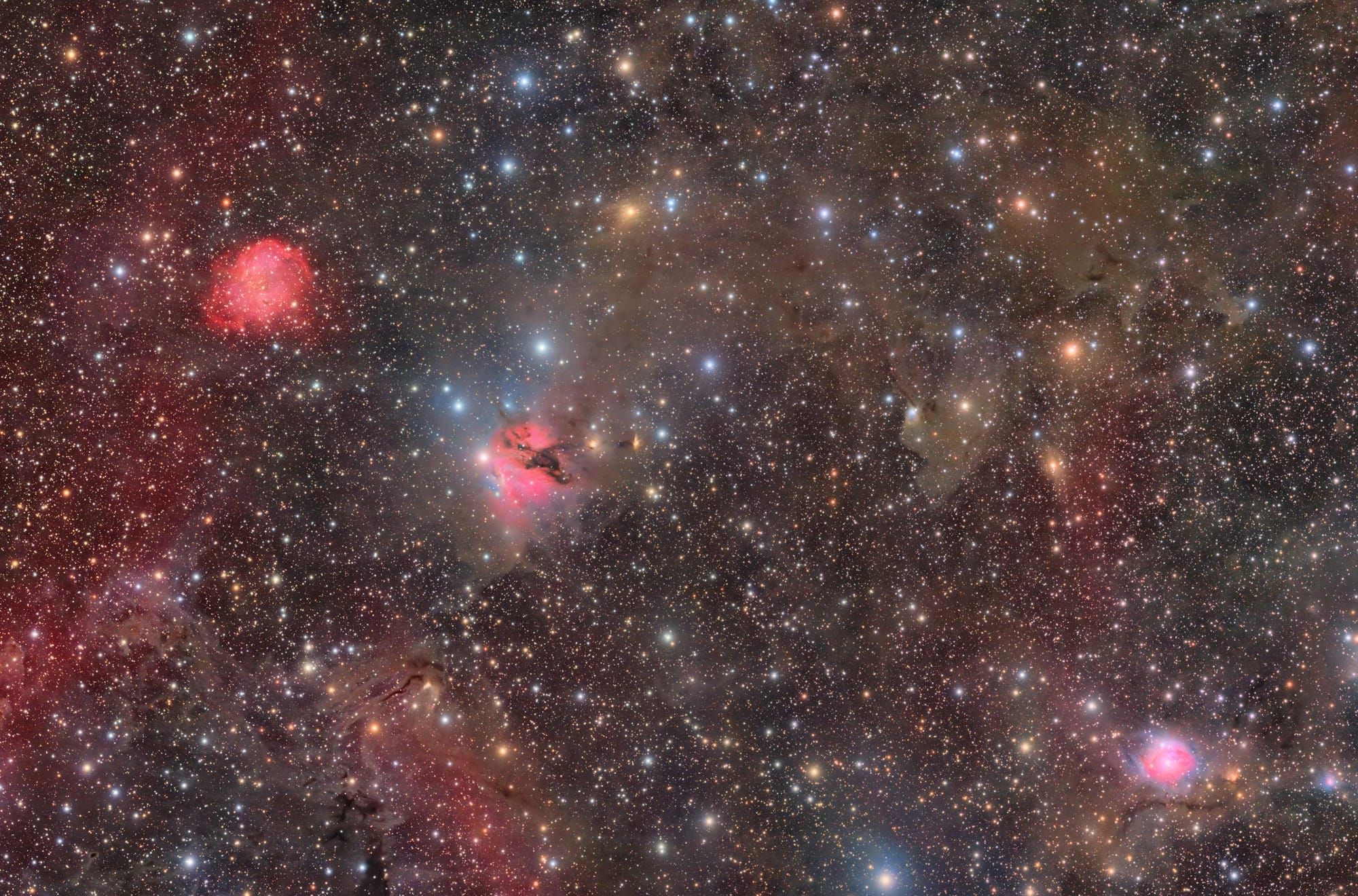
Dorrie Vance collected catalogs the way other rich people collected moons. She owned the Sharpless list in its final 1959 form, three hundred and thirteen clouds of glowing hydrogen. She owned Beverly Lynds's eleven hundred and twenty-five bright nebulae, each graded from one to six, one for brilliant and six for barely there. She owned the 1982 list of radio velocities that Blitz, Fich and Stark had measured toward those same clouds. What she wanted from me was a correction. “Two ninety-one,” she said, tapping the chart. “It glows. Nothing lights it. Go find the lamp.”
I am a pilot, not an astronomer, so I read the file on the way out. Nearly every cloud in the Sharpless list is an emission nebula, and an emission nebula is a simple machine: a hot star pours out ultraviolet, the ultraviolet strips electrons off hydrogen, and the hydrogen glows red when they fall back. No hot star, no glow. Sh2-291 glowed. The carbon monoxide velocities put it about eight thousand parsecs out, some twenty-six thousand light-years, in the far outer arm of the galaxy. And in all the literature, nobody had ever named the star that lit it. The only thing cataloged nearby was EM Monocerotis, a cool carbon star, which is to say a red giant full of soot. A carbon star could not ionize a birthday candle.
From old Earth the whole field sits low in the winter south, tangled in a crowd of other things: the dark cloud LDN 1655, the reflection nebula vdB 87 glowing blue, the soft smear of LBN 1022, a second small emission cloud called BFS 63. Two observers once spent sixty-four hours between them just pulling the faint parts out of the murk near the horizon. I had a ship. I went around.
It took three weeks of flying and one afternoon of looking. From the Earthward side the cloud was a red ghost. From the far side it was a blue-white star so bright it hurt, sitting in a pocket it had carved for itself, with a thick wall of its own dust between it and every observer in human history. The ultraviolet leaked out around the edges and lit the gas we could see. The lamp had been inside the lampshade the whole time.
I called Dorrie from the pocket and described it to her: spectral lines, position, the works. There was a long pause on her end. Then she doubled my fee, on the condition that I never publish a word of it. “Anyone can own a solved entry,” she said. “I am the only woman alive who owns a mystery.”
Top Pick
64h 10m
Feb 26 to Mar 6, 2025 (9 nights)
Lum: 23h 30m (141 × 600″)
Red: 7h 30m (45 × 600″)
Green: 7h 20m (44 × 600″)
Blue: 7h 30m (45 × 600″)
H-alpha: 18h 20m (110 × 600″)
Telescope: Takahashi TOA-130NFB
Camera: ZWO ASI6200MM Pro
Mount: 10Micron GM1000 HPS
Mount: Sky-Watcher EQ8-R Pro
Flattener: Takahashi 645 Flattener for TOA-130 (TKA31587S)
Focuser: Pegasus Astro FocusCube2
Filter Wheel: ZWO EFW 7 x 2″
Rotator: Pegasus Astro Falcon Rotator 2
Power: Pegasus Astro Powerbox Advance Gen2
Flat Panel: DeepSkyDad Flap Panel (FP1)
Astronomik L-3 Luminance UV/IR Block 2", Chroma Lum 50 mm, Astronomik Deep-Sky Red 2", Chroma Red 50 mm, Astronomik Deep-Sky Green 2", Chroma Green 50 mm, Astronomik Deep-Sky Blue 2", Chroma Blue 50 mm, Astronomik H-alpha CCD 6nm 2", Chroma H-alpha 3nm Bandpass 50 mm
Pleiades Astrophoto PixInsight, Russell Croman Astrophotography BlurXTerminator, Russell Croman Astrophotography NoiseXTerminator, Russell Croman Astrophotography StarXTerminator
DSP Remote Observatory: Animas, NM: Bortle 1
View the full-resolution image and technical details on AstroBin.