
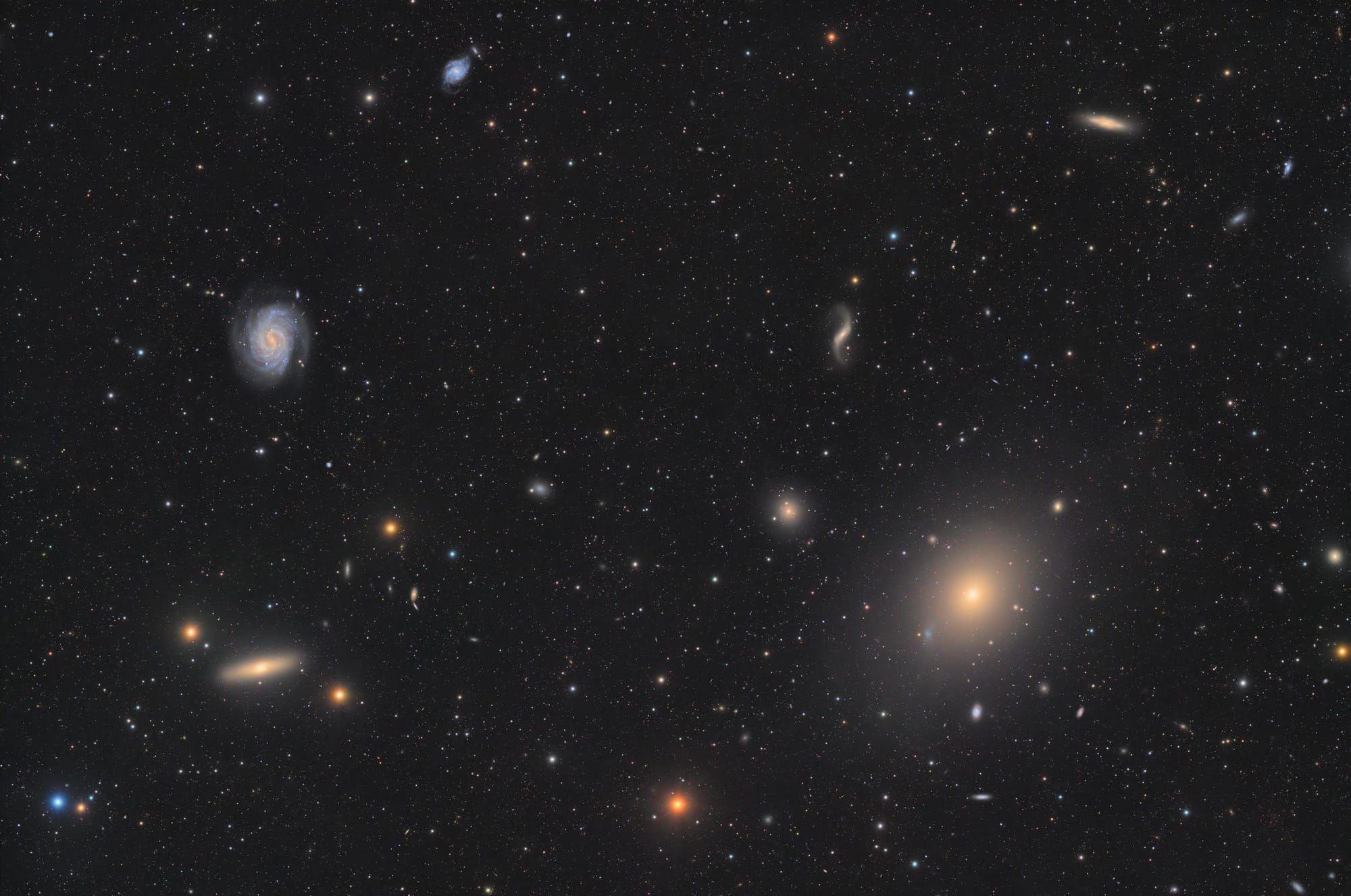
The jump drive worked perfectly, and I want that on the record, because everything after it was my fault. I came out of transit expecting the Tau Ceti relay and got a sky full of fuzzy blobs instead. No relay. No beacon. The nav computer took one look and threw an error I had never seen, which translated roughly to "I have no idea, and I resent the question." Fine. I'm a navigator. I'll do it by hand.
Step one: find the biggest thing in the sky. Easy. A giant elliptical galaxy hung off the starboard side like an overexposed egg, and its halo was crawling with globular clusters. I counted one patch, did the area math, and got close to six thousand. I know exactly one galaxy with about 5,900 globulars that sits in the middle of its own crowd of galaxies: M49, the anchor of the Virgo Cluster's B subcluster. Charles Messier logged it in 1771, the first Virgo galaxy anybody ever found. Congratulations to me. I was roughly fifty-six million light-years from home.
Always check your work, so step two was an independent distance. Off to the left sat a big, loose, blue spiral, faint enough that people back home nicknamed it the Lost Galaxy. NGC 4535. In 1999 the Hubble Space Telescope picked out Cepheid variables in it, stars whose pulse rate tells you how bright they really are, and the answer came out at about 52 million light-years. I found three Cepheids, timed them for three weeks, ran the period-luminosity relation on what was basically a napkin, and landed inside the error bars. Two methods, one answer. I hate it, but it's right.
Step three was purely for spite. Below the spiral sat a lenticular, NGC 4526, with a dust lane like a drawn-on eyebrow. It was the first galaxy to have its central black hole weighed by watching molecular gas swirl around the core with an interferometer: about 450 million Suns. I pointed the spectrometer at the gas disk, measured the rotation, and got the same monster. At least the universe was being consistent. That is more than I can say for my nav computer.
So here's the situation. My distress beacon travels at the speed of light, and the nearest person who could hear it is fifty-some million light-years away. By the time anyone gets the message, M49 will have finished shredding the little dwarf galaxy it is already chewing on, and nobody will remember what a navigator was. On the bright side, I have six years of food, a working jump drive, and three independent measurements of exactly where I am. Turns out that's all you need. I reversed the last jump and went home. It's not a rescue if you do the math yourself.
Top Pick
16h 30m
Apr 25 to Apr 28, 2025 (4 nights)
Lum: 7h 30m (45 × 600″)
Red: 3h (18 × 600″)
Green: 3h (18 × 600″)
Blue: 3h (18 × 600″)
Telescope: Takahashi TOA-130NFB
Camera: ZWO ASI6200MM Pro
Mount: 10Micron GM1000 HPS
Flattener: Takahashi 645 Flattener for TOA-130 (TKA31587S)
Focuser: Pegasus Astro FocusCube2
Filter Wheel: ZWO EFW 7 x 2″
Rotator: Pegasus Astro Falcon Rotator 2
Power: Pegasus Astro Powerbox Advance Gen2
Flat Panel: DeepSkyDad Flap Panel (FP1)
Chroma Lum 50 mm, Chroma Red 50 mm, Chroma Green 50 mm, Chroma Blue 50 mm
Pleiades Astrophoto PixInsight, Russell Croman Astrophotography BlurXTerminator, Russell Croman Astrophotography NoiseXTerminator, Russell Croman Astrophotography StarXTerminator
DSP Remote Observatory: Animas, NM: Bortle 1
View the full-resolution image and technical details on AstroBin.