
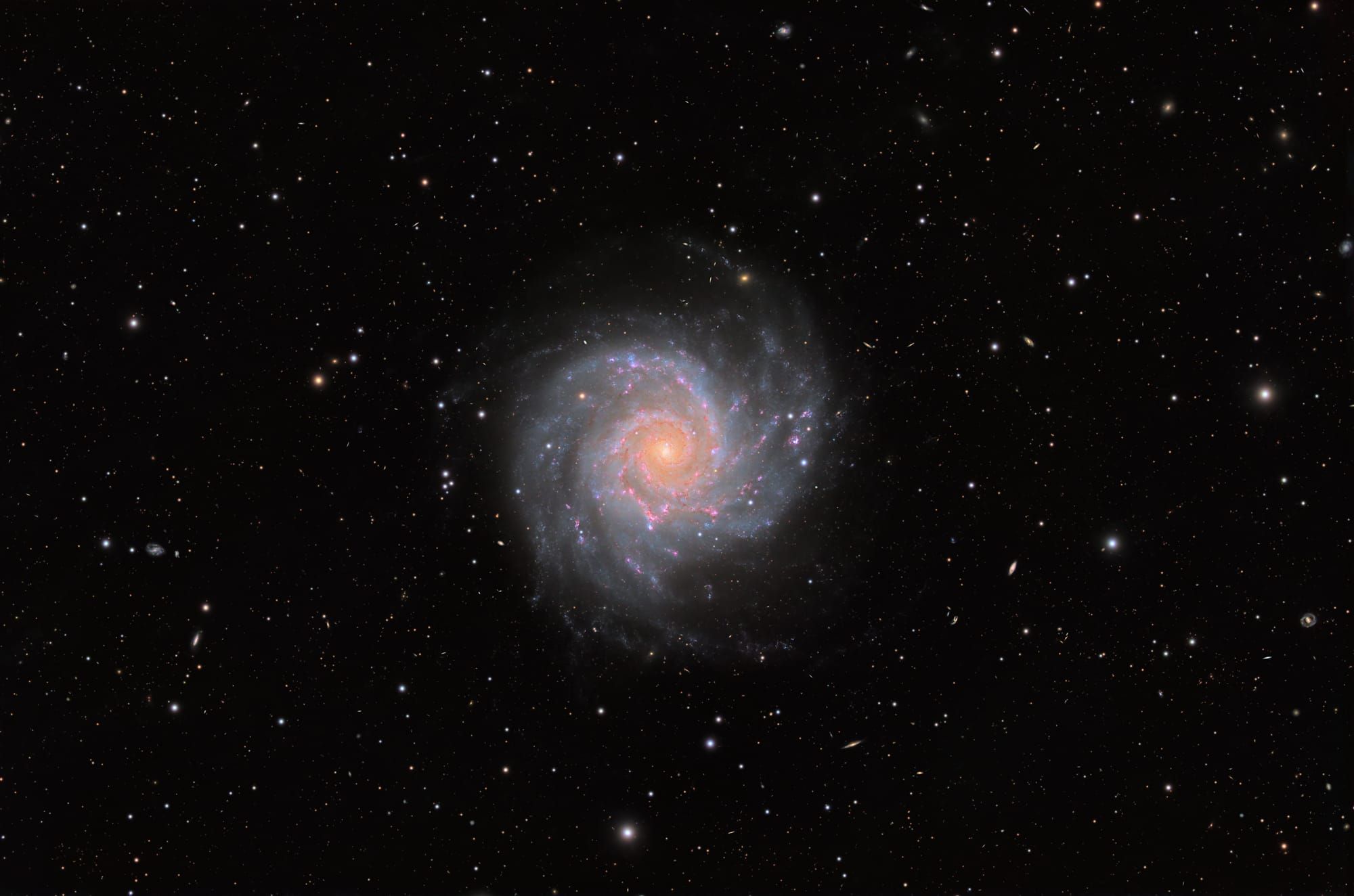
Wind gusts above about 11 mph wrecked my declination guiding and stretched my stars during a night of imaging at DSP Remote in Animas, New Mexico. Below that line, 30 of 31 five-minute subs came out round. Above it, 19 of 33 were visibly elongated, while right ascension guiding barely moved.
I didn't go looking for a wind story. I went looking for why my guiding "gets terrible overnight" on some nights and not others, and why my star sizes balloon after midnight. So I lined up every sub against the guide log, the autofocus runs, and the weather station readings stored in each FITS header. One night stood out, and it's a clean example of what wind does to a long focal length rig, whatever software happens to be running it.
The rig and the night
The setup is my Celestron EdgeHD 11 with the 0.7x reducer (1,960 mm at f/7), a ZWO ASI2600MM Pro at 0.40″ per pixel, and an off-axis guider feeding an ASI174MM Mini at 0.62″ per pixel. It all rides on a 10Micron GM1000 HPS, a premium mount with absolute encoders on both axes, under Bortle 1 skies. The target was M76, the Little Dumbbell, in LRGB with 300-second subs from 7:43 pm to 3:25 am on October 15–16, 2026.
The software matters less than you'd think here, and the wind certainly doesn't care. Guiding ran in PHD2, the free, open-source guiding application available for macOS, Windows and Linux. Everything else in this post comes from things any rig can record: the guide log, the subs themselves, and the site's weather readings saved in each FITS header. The measuring is where my Mac does the work, and I'll get to that.
Why did my guiding fall apart overnight?
On calm nights this rig guides at 0.22–0.40″ total RMS for most of the night. October 15 started the same way. Then, a little after 11 pm, the site's weather station started reporting gusts of 9 to 18 mph. RA guiding stayed around 0.3–0.5″. Dec went from 0.3″ to as much as 3″ RMS per sub, with individual jumps as large as 11.8″.
That pattern is the giveaway. Bad seeing smears both axes and makes the guider chase noise in RA and Dec alike. A drifting polar alignment shows up as a slow, steady creep. This was neither. Dec jumped suddenly, in both directions, then took minutes to come back while RA carried on as if nothing happened.
Is it the wind or just bad seeing?
I measured the stars on all 68 subs to find out. If seeing were the cause, the stars would grow but stay round. Instead, from 11:20 pm on, they stretched, and the elongated frames all pointed within about 20° of the same angle, lined up with the Dec axis at this framing. Across the night, star eccentricity tracked Dec guiding error with a correlation of 0.87, and wind gusts with a correlation of 0.72.
For contrast, a band of thin cloud passed through between 10:35 and 10:56 pm. Those subs bloated to 3.2–3.5″, but their stars stayed round. The sky temperature jumped six degrees, the star count halved, and PHD2 lost its guide star more than a dozen times. That's what transparency looks like in the data. Wind has a different fingerprint.
Why Dec and not RA? I don't have a wind direction sensor, so this part is an inference. M76 sits at +51° declination, which put the scope high in the north for most of the night. In that position the Dec axis carries very little gravitational load, and an 11-inch tube makes a decent sail. A better mount doesn't change that. The GM1000 HPS is about as good as mounts in this class get, and it still can't overcome the physics of moving air pushing on a big tube. My PHD2 settings didn't help either. With Dec aggressiveness at 20%, a 5″ error got a correction worth less than 1″, so every gust took one to three minutes to recover inside a five-minute sub.
How much wind is too much for astrophotography?
There isn't a universal number, and anyone who gives you one without a focal length and a mount attached is guessing. For this rig, the line fell at about 11 mph gusts (18 km/h).
That lines up with what long focal length imagers report on forums. AstroBin users describe guide graphs jumping more than half an arcsecond on 5 mph gusts, and owners of heavy SCTs on mid-size mounts saying anything beyond a light breeze ends the night. Professional observatories like the MMT start closing up at 30 to 40 mph, but they're protecting a 6.5-meter mirror, not chasing 0.4″ guiding.
Two caveats. The wind value is the reading when each sub started, not an average over five minutes, so it understates what the scope felt during the exposure. And this is one night on one target. Your line depends on your mount, your tube, your pier, and which way the wind blows relative to where you're pointing.
You might assume the roof takes care of this. It doesn't, at least not for image quality. DSP's roof has its own wind limit, and that's most likely what closed it at 12:46 am. By then, 13 of the previous 15 subs were already elongated, about 85 minutes of wasted exposure. When the roof reopened at 1:47 am, the wind hadn't really let up. The night's highest gust reading came at 2:09 am, and 8 of the next 16 subs stretched. The roof's threshold is there to protect the equipment. Protecting the data is up to you.
What should you do on a windy night?
Very little of this needs new gear. Most of it is about seeing the problem in your own data and making the sequence react to it.
Every weather reading in this post came from the subs themselves. When a weather station is connected, the capture software stamps its readings into each frame's FITS header, right alongside the exposure time, filter and focuser position. Here's what that looks like for two subs from this night, one I kept and one I culled.
That turns culling into a two-step check. Pull the WINDGUST keyword for every sub to find the stretch of the night that's suspect, then confirm with measured eccentricity before you throw anything away. Wind alone isn't proof. Fourteen of the 33 gusty subs on this night still came out round, and the cloud subs were bad for a completely different reason. The header tells you where to look; the stars tell you what to keep.
Reject by shape, not by feel. Sort subs by eccentricity in PixInsight's SubframeSelector or Siril, both Mac-native, and drop anything over about 0.5 before stacking.
Let Dec recover faster. My PHD2 Dec aggressiveness sat at 20%, so each gust took one to three minutes to correct. I'm testing 50–60% on Lowpass2.
Save high northern targets for calm nights. Pointing high in the north gave the wind the most leverage on the Dec axis of an 11-inch tube.
Record the weather in every FITS header. Most capture apps can write weather station readings into each sub when a weather device is connected. Check that yours does. That's what made this analysis possible.
The Mac side of this workflow is the measuring. PixInsight and Siril both run natively on Apple Silicon and will score every sub for FWHM and eccentricity in a few minutes. Our Mac Astronomy Software directory lists both, along with the other sub-analysis tools that run on macOS.

The bigger lesson for me is that "guiding got bad" isn't a diagnosis. On the other nights I looked at, late-night star bloat came from the sky, not the mount, and on this one it came from the wind. Put the weather in your FITS headers, measure your subs, and the data will tell you which problem you're actually solving.