
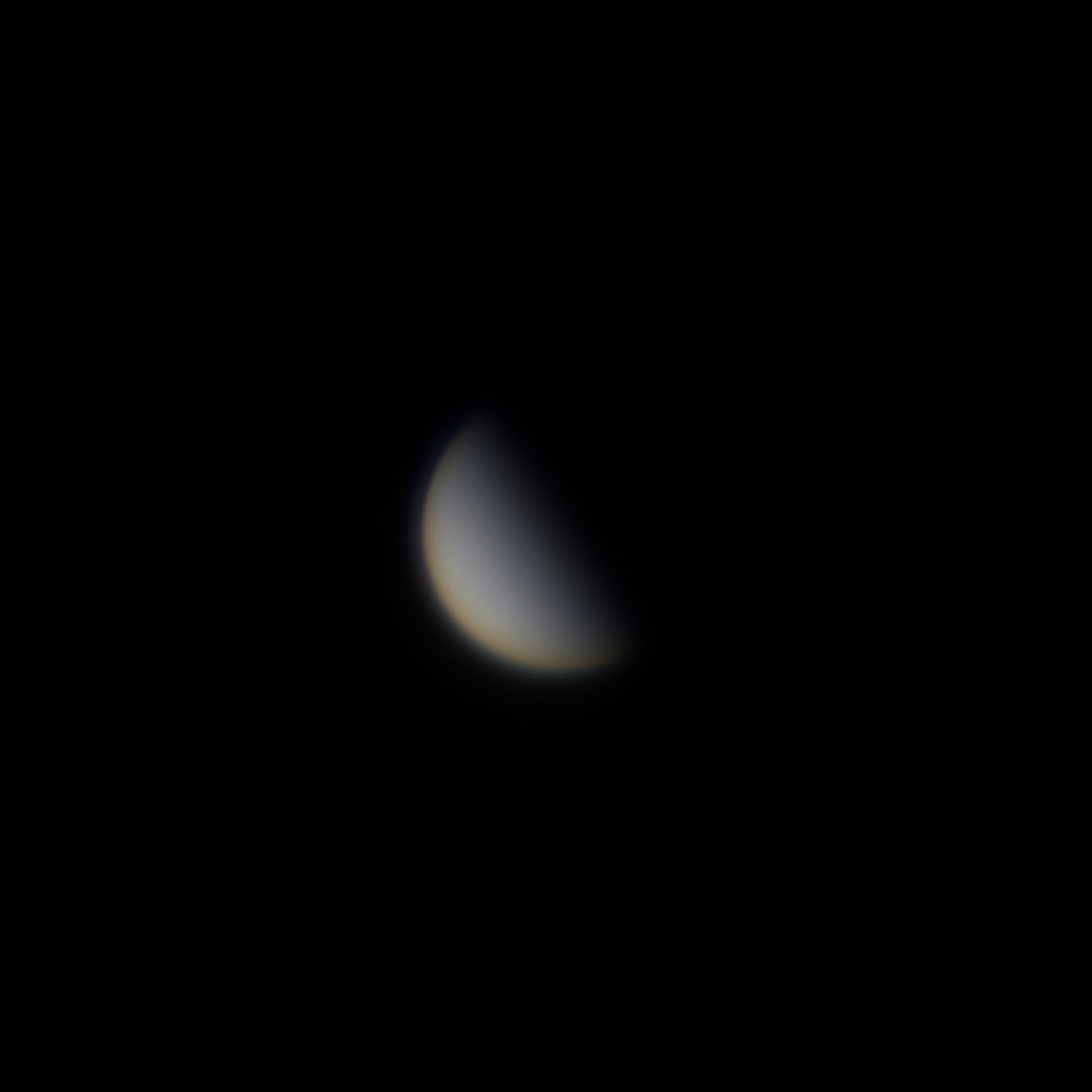
Venus near dichotomy, twenty minutes after sunset from my driveway in Pearland, Texas. 10,000 frames through an EdgeHD 8 and a 2.5x Powermate, recorded in Laminar 1.5.9 and taken the rest of the way in Strata.
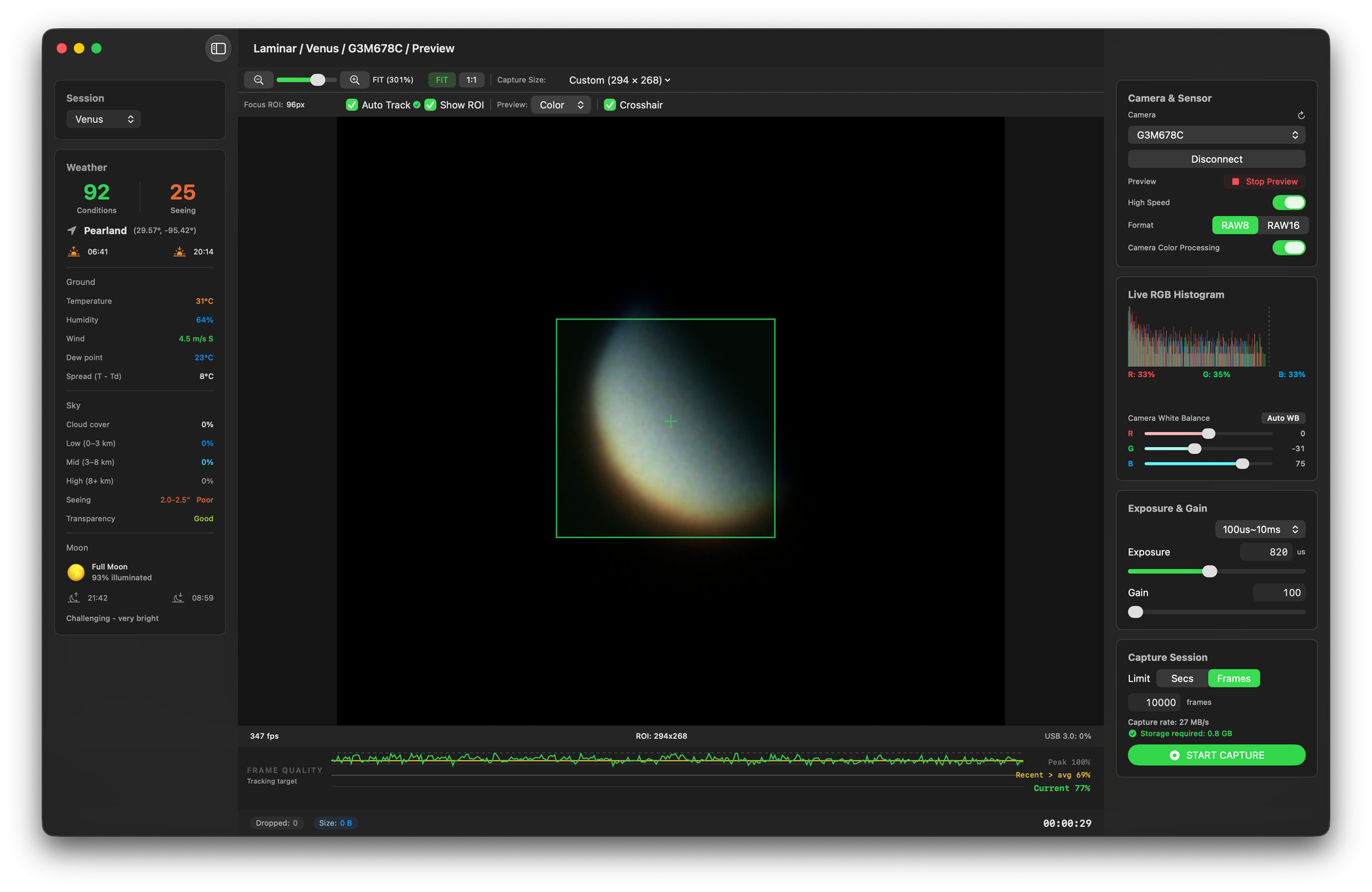
The conditions were not good and Laminar said so before I started. The sky panel put seeing at 2.0 to 2.5 arcsec and called it poor, which matched what the frame quality graph did for the entire run: a steady sawtooth, nothing settling. It was 31°C at sunset with 64% humidity and an SCT that had not finished dumping its heat. The Powermate puts me at 5080mm and f/25, and with 2 micron pixels that is heavily oversampled by any normal rule. On Venus I will take it. The disk is bright enough to afford the focal ratio, and there is no fine surface detail to lose in the first place.
The whole capture is 29 seconds. 10,000 frames at 347 fps in a 294x268 ROI, RAW8, high speed mode, 820 microseconds a frame at gain 100. Venus does not rotate on any timescale that matters here, so unlike Jupiter and its roughly 90 second window, there was no clock running. I could have shot for three minutes and stacked far more good frames. I didn't, and that is the part of the night I would do differently.
Strata took the best 9% through Strata Warp, then light wavelets and a small color pass. Venus in visible light gives a local-alignment stacker almost nothing to hold onto: no surface markings, just a bright smooth crescent and a terminator that fades rather than ends. It held together, but this is the least forgiving target I have thrown at it.
I don't own an ADC, and at that altitude atmospheric dispersion pulls the red and blue channels apart badly enough to see at a glance. Strata's Color phase put them back into register, which is what the channel alignment is there for, and it did most of the work in software that the hardware would have done at the telescope. What survives is a little warmth on one limb and a cooler cast on the other. I stopped there. The rest of the color is close to what came off the sensor.
Next time: a daytime capture with Venus high, and a UV pass. Visible light gets you the phase and not much else. The cloud structure lives in the ultraviolet.
10,000 × 0.82 ms
347 fps, gain 100, RAW8, best 9% stacked
Telescope — Celestron EdgeHD 8
Amplifier — Tele Vue 2.5x Powermate (5080mm, f/25)
Camera — ToupTek G3M678C
Mount — Rainbow Astro RST-135E on an Astro-Physics Eagle pier
Seeing 2.0 to 2.5″, transparency good, 31°C, 64% humidity
Pearland, TX
View the full-resolution image and technical details on AstroBin.