
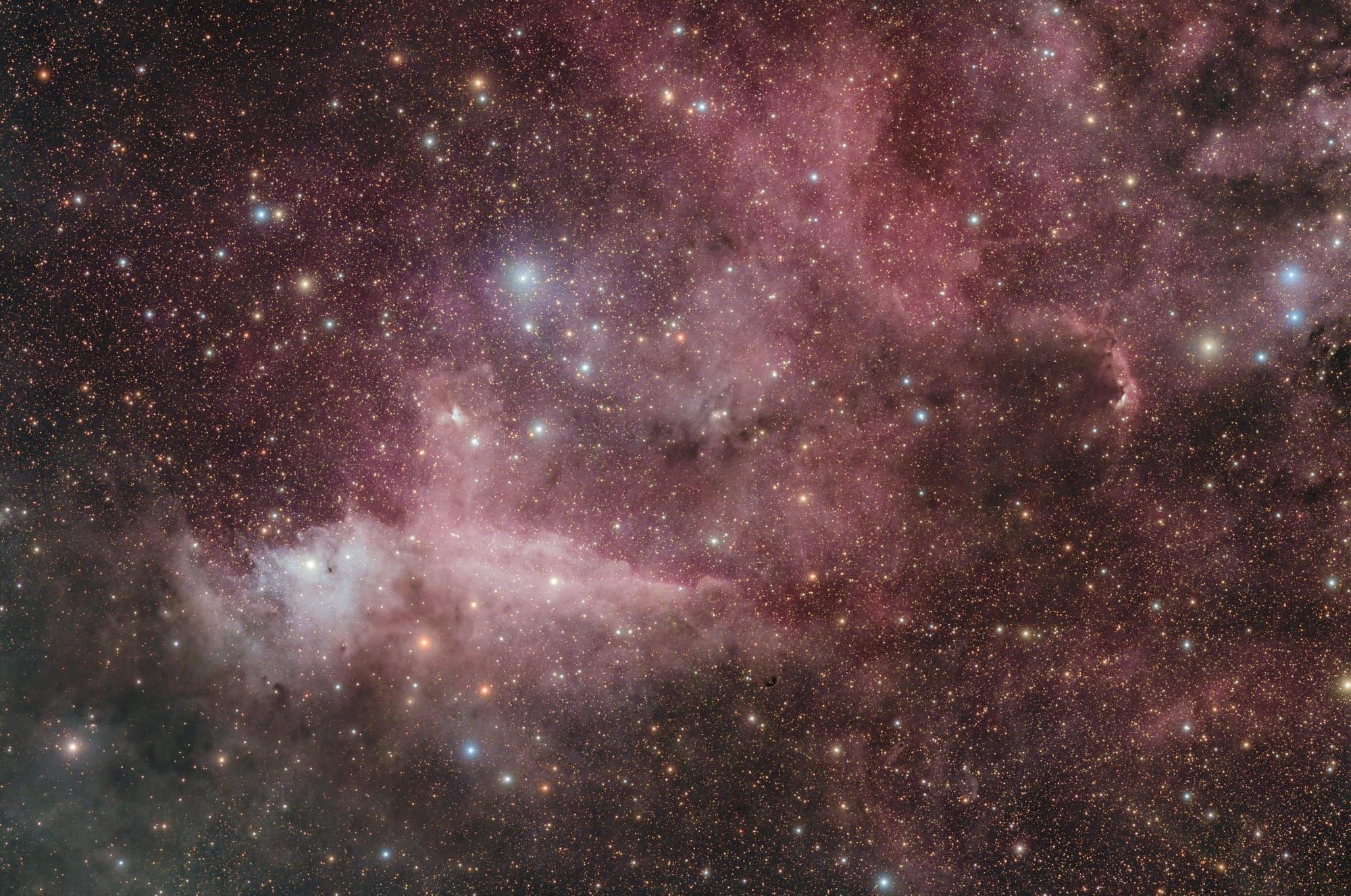
The Commission for the Final Characterization of Reflection Nebula No. 154 was convened, as such commissions are, long after anyone could remember why it was needed. Its mandate was simple. In 1966 an astronomer named van den Bergh had gone through the red and blue prints of the Palomar Sky Survey and written down every catalog star north of declination minus thirty-three that sat in a veil of dust visible on both prints. He found one hundred and fifty-eight. The Commission's task was to say, at last and definitively, what the one hundred and fifty-fourth actually was.
This proved harder than the budget had anticipated. The object lay in Cepheus beside a red emission cloud, Sharpless 150, and the first subcommittee proposed that the two were related. The second subcommittee noted that the distance to No. 154 was not known, so no physical link could be claimed at all; the pair might be neighbors, or strangers who happened to line up along a sight line thousands of light-years deep. The third subcommittee observed that 26 Cephei, a hot blue supergiant shining in the same field, was the most conspicuous thing present, and moved that it be declared responsible. The motion failed for lack of evidence and passed, two sessions later, for lack of a better idea.
Dr. Halina Wiertel was assigned the minority report. She requested twenty-five hours of exposure, which the Commission considered an extravagance, and spent most of the following year looking at the result. A reflection nebula, she wrote, is the most modest object in the heavens. It makes no light of its own. It does not burn, ionize, or announce itself. It merely returns, scattered and bluer, whatever light happens to fall on it. Asking such a thing what it is resembles asking a mirror for its opinion: every answer turns out to be a description of the questioner.
The Commission found this unhelpful. It pointed out that dust grains have sizes, compositions, and orientations, all measurable in principle. Wiertel agreed. In principle, she replied, everything can be measured, and the history of astronomy consists chiefly of the distance between that principle and the budget. One could determine the grains to the last micron and still not know where the cloud lay, what lit it, or why it had gathered there rather than anywhere else. One would possess a complete description of the reflection and no knowledge whatsoever of the thing reflected.
The final report ran to eleven hundred pages and concluded that No. 154 was a reflection nebula. It was adopted unanimously. Wiertel's minority report ran to one sentence and was filed under the same number, where it may still be consulted by anyone with the proper clearance. It read: "We looked into it for twenty-five hours, and it looked back, and each of us saw exactly what we had brought."
Top Pick
25h
Oct 4 to Oct 5, 2023 (2 nights)
Lum: 8h 20m (50 × 600″)
Red: 2h 40m (16 × 600″)
Green: 2h 40m (16 × 600″)
Blue: 2h 40m (16 × 600″)
H-alpha: 8h 40m (52 × 600″)
Telescope: Takahashi TOA-130NFB
Camera: ZWO ASI6200MM Pro
Mount: 10Micron GM1000 HPS
Flattener: Takahashi 645 Flattener for TOA-130 (TKA31587S)
Focuser: Pegasus Astro FocusCube2
Filter Wheel: ZWO EFW 7 x 2″
Power: Pegasus Astro Powerbox Advance Gen2
Flat Panel: DeepSkyDad Flap Panel (FP1)
Chroma Lum 50 mm, Chroma Red 50 mm, Chroma Green 50 mm, Chroma Blue 50 mm, Chroma H-alpha 3nm Bandpass 50 mm
Aries Productions Astro Pixel Processor (APP), Pleiades Astrophoto PixInsight, Russell Croman Astrophotography BlurXTerminator, Russell Croman Astrophotography NoiseXTerminator, Russell Croman Astrophotography StarXTerminator
DSP Remote Observatory: Animas, NM: Bortle 1
View the full-resolution image and technical details on AstroBin.