
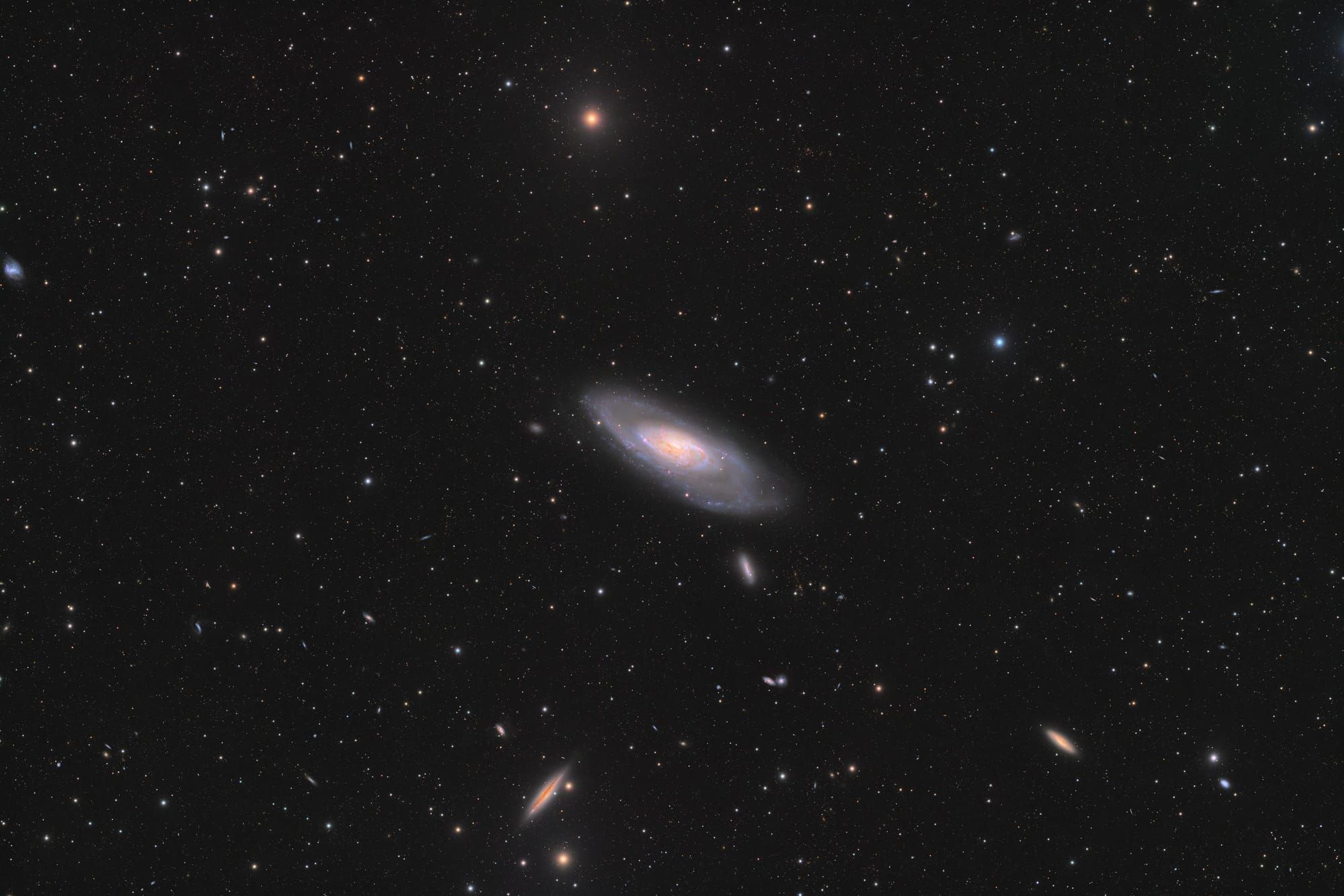
In my profession we were taught early that no distance is ever measured alone. The distance to one lamp is inferred from the distance to the lamp before it, and that from the one before, all the way down to a baseline our predecessors measured within our own small neighborhood of space. We called this the Ladder, and we revered it, and preferred not to look too closely at its lower rungs. Every error in them was inherited by everything above.
What changed my life was a galaxy about twenty-four million light-years away, the hundred and sixth entry in Messier's list, first noted by Pierre Méchain in 1781. At its heart lies a black hole of roughly forty million suns, and around that black hole turns a thin disk of gas, seen almost exactly edge-on. Within the disk, less than a light-year from the center, are clouds of water vapor that behave as masers: they amplify microwave radiation into narrow, brilliant spectral lines, each one a beacon whose motion can be read with exquisite precision.
The method is almost embarrassingly simple. Because the clouds obey Kepler's rules, as planets do around a star, their speeds in kilometers per second can be known from the spectrum alone. The clouds on the near face of the disk also creep across the sky from year to year, a motion that can only be measured as an angle. The speed is the same motion expressed in distance, the drift is the same motion expressed in angle, and so the ratio between them is simply how far away the galaxy is, owing nothing to any rung below. It was the first direct measurement of the distance to another galaxy. When I first worked the numbers I felt a kind of vertigo: the Ladder was not the only way up.
The second revelation came more slowly and troubled me more. The galaxy has two extra arms, faint in visible light but bright in radio waves and X-rays, that no theory of spiral structure predicted. They are not arms at all. Jets from the black hole strike the disk and drive shock waves through it, heating its gas and flinging it outward. By one estimate two-thirds of the gas at the galaxy's center is already gone, and the rest will follow within about three hundred million years unless something replenishes it. Without gas there will be no new stars there.
People ask why this saddens me, given the timescale. It is not the loss. It is that one engine does both things. The water that let us measure the galaxy orbits the very thing that is emptying it; the ruler and the wound are the same. I had believed that knowing a thing's distance meant knowing only where it stood. I did not understand, until then, that to measure a thing is sometimes to read its future, and that the future does not change because you have read it.
Top Pick
41h 20m
Mar 3 to Mar 8, 2024 (6 nights)
Lum: 14h (84 × 600″)
Red: 4h 40m (28 × 600″)
Green: 4h 40m (28 × 600″)
Blue: 4h 40m (28 × 600″)
H-alpha: 6h 40m (40 × 600″)
OIII: 6h 40m (40 × 600″)
Telescope: Takahashi TOA-130NFB
Camera: ZWO ASI6200MM Pro
Mount: 10Micron GM1000 HPS
Flattener: Takahashi 645 Flattener for TOA-130 (TKA31587S)
Focuser: Pegasus Astro FocusCube2
Filter Wheel: ZWO EFW 7 x 2″
Power: Pegasus Astro Powerbox Advance Gen2
Flat Panel: DeepSkyDad Flap Panel (FP1)
Chroma Lum 50 mm, Chroma Red 50 mm, Chroma Green 50 mm, Chroma Blue 50 mm, Chroma H-alpha 3nm Bandpass 50 mm, Chroma OIII 3nm Bandpass 50 mm
Aries Productions Astro Pixel Processor (APP), Pleiades Astrophoto PixInsight, Russell Croman Astrophotography BlurXTerminator, Russell Croman Astrophotography NoiseXTerminator, Russell Croman Astrophotography StarXTerminator
DSP Remote Observatory: Animas, NM: Bortle 1
View the full-resolution image and technical details on AstroBin.