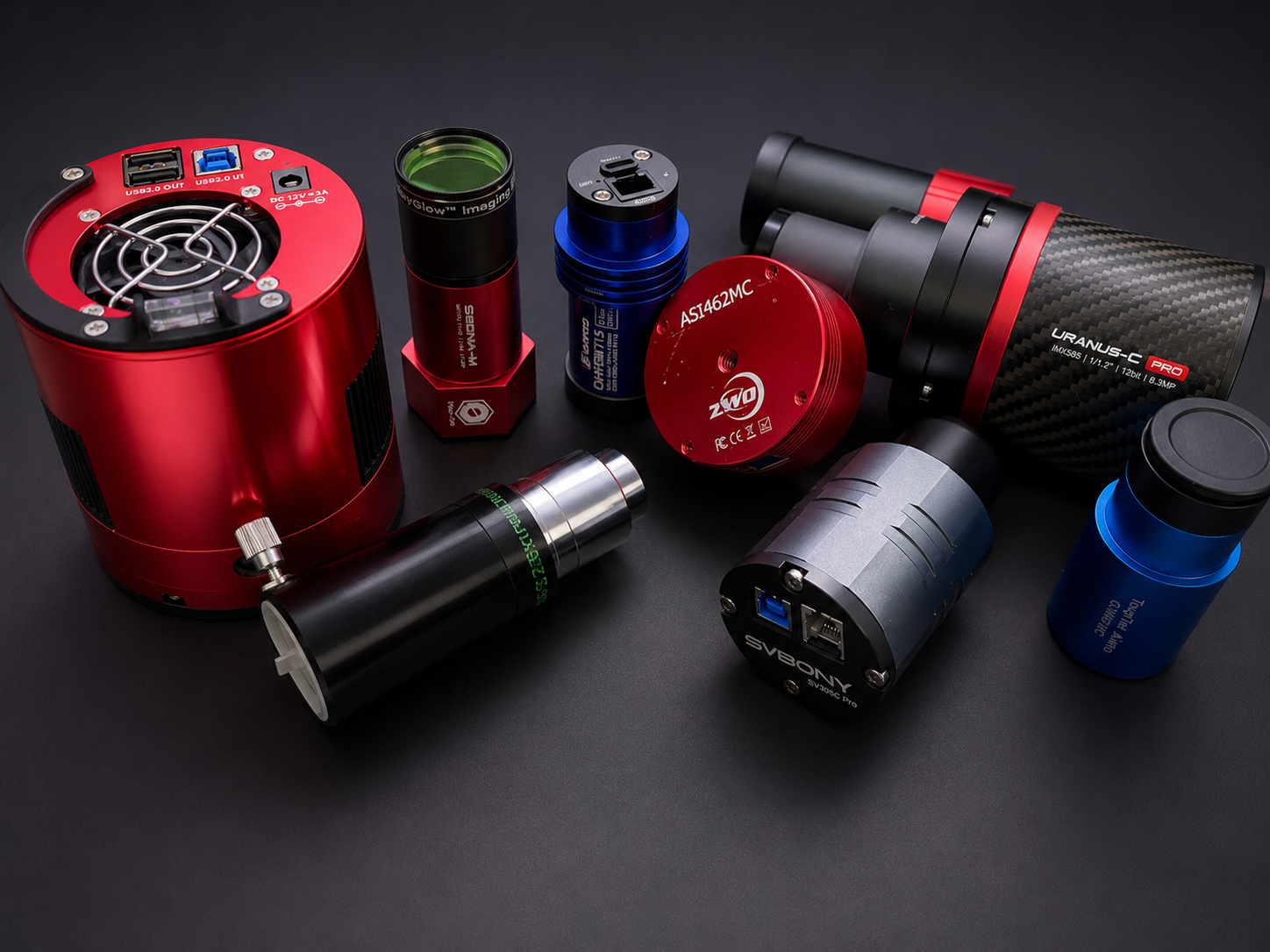
A planetary camera and a deep-sky camera are built from opposite requirements. One reads a small patch of sensor thousands of times a minute. The other holds a large patch still for minutes at a time. Almost every difference between the two categories follows from that one split.
If you already own a cooled CMOS camera for nebulae and galaxies and you're wondering whether it can pull double duty on Jupiter, the short answer is usually yes, with conditions attached. The longer answer is worth having, because the conditions are where the money is.
I'm using the ZWO ASI533MC Pro as the running example. It sits right on the boundary, plenty of Mac users own one, and it comes up in nearly every forum thread on this question. Understanding why it's a compromise for planetary work explains the whole category split.
Why frame rate is the number that decides it
Planetary imaging runs on lucky imaging. You shoot video, hundreds or thousands of short frames, then throw away the worst ones and keep only the moments when the atmosphere briefly settled. Stack what survives and you recover detail no single frame could show cleanly.
The mechanism is frame count, and the arithmetic is unforgiving. The ASI533MC Pro runs at 20 fps across its full 3008 x 3008 frame. A three minute capture gets you 3,600 frames. Reject the worst 80%, which is a normal keep rate in mediocre seeing, and you're stacking 720. Crop that same camera to a 640 x 480 region of interest and it runs at 116.55 fps. The same three minutes now yields about 21,000 frames, and the same 20% keep rate leaves you roughly 4,200 to stack.
That's not a marginal gain. It changes how aggressively you can select for quality and still end up with a deep result.
That 117 fps figure is competitive for planetary work, and I want to be clear about that up front. The ASI533MC Pro is not a bad planetary camera. What matters is understanding what ROI costs and why some cameras handle it better than others. The ZWO ASI2600MC Pro, for comparison, reaches only about 28 fps at that same 640 x 480 crop. The 533 does this considerably better than most large-format DSO cameras.
The four specs underneath the frame rate
Frame rate is the headline. It sits downstream of four other specifications, and those four are what actually define the categories.
Pixel size. Planetary imaging resolves fine detail at long focal length, and smaller pixels give you more samples per arcsecond when your optics can deliver them. The ASI533MC Pro has 3.76 µm pixels. The ASI678MC, a dedicated planetary camera, has 2.0 µm. On a Celestron EdgeHD 11 at 2,800 mm, that's 0.28 arcsec per pixel against 0.15. The gap is real, but the 533 isn't out of range. Call it meaningful rather than disqualifying. Worth knowing that at native f/10 the 533 is actually undersampled on an SCT and wants a Barlow to reach its target range, which is a cheaper fix than a new camera.
Pixel count, not sensor size. Sensor area gets blamed for slow frame rates and it's the wrong culprit. Readout time tracks pixel count and bit depth. The ASI585MC has a 1/1.2 inch sensor with 8.29 million pixels and reads at 46.9 fps. The ASI662MC has a smaller 1/2.8 inch sensor with 2.07 million pixels and reads at about 103 fps. The ASI533MC Pro, at 9 million pixels and 14-bit, manages 20.
Physical area still matters, for a different reason. On a long focal length scope a planet occupies a small patch of sky, and a large sensor spends most of its readout budget on empty black. That's precisely the problem ROI mode exists to solve.
Something worth knowing before you shop: the newer 8 megapixel planetary cameras aren't fast wide open either. The ASI678MC tops out at 47.5 fps across its full 3840 x 2160 frame. They reach planetary frame rates by cropping, same as a DSO camera does. What you're buying is a better starting point, smaller pixels and a faster-reading sensor, so the crop you end up with is more useful. The classic small planetary cameras are the exception: the ASI662MC really does run at 103 fps with nothing cropped.
Cooling. This one favors the simpler option. Deep-sky imaging accumulates thermal noise because individual exposures run for minutes. Planetary frames are measured in milliseconds and the sensor has time to shed heat between captures. Cooling adds cost and mechanical complexity that planetary-only imagers don't need. An uncooled planetary camera is a design decision, not a corner cut.
Read noise. This is the one I had backwards for a long time. The intuition says high gain amplifies everything including noise, so planetary capture at high gain must be noisy. Modern CMOS sensors work the other way around. Most of these cameras have a high conversion gain mode that switches in above a threshold and cuts read noise measured in electrons. On the ASI462MC, HCG engages at gain 80 and read noise falls to 0.47e. The ASI533MC Pro runs from 3.8e at low gain down to 1.0e at high gain. The ToupTek G3M678C spans 2.43e down to 0.42e.
Planetary capture lives at the clean end of that range, which is convenient, because that's exactly where you have to be to keep exposures short enough to freeze the seeing.
Matching the camera to the telescope
Pixel size only means something in combination with focal length. The number that matters is pixel scale, how much sky each pixel covers, and it comes from one formula.
Once you have pixel scale, compare it against what your telescope can actually resolve. Aperture sets that ceiling, and no amount of magnification moves it. A 203 mm aperture resolves about 0.68 arcsec. An 11 inch resolves about 0.49. If your pixels are much coarser than that limit you're throwing away detail the optics are handing you. If they're much finer you're spreading the same detail across more pixels, which costs you frame rate and signal per pixel and buys nothing.
For planetary work the usual target is a focal ratio somewhere around four to six times your pixel size in microns for a color camera, or three to four and a half for mono, since a Bayer matrix samples each color more coarsely than the pixel grid suggests. On an ASI533MC Pro with 3.76 µm pixels that puts the target at roughly f/15 to f/23. Run one at native f/10 on an SCT and you're undersampled, which is worth knowing before you conclude the camera is the problem.
Undersampling isn't fatal, incidentally. Drizzle at 2x or 3x during stacking recovers some of it when your frame count is high, which is one more reason frame rate keeps turning up as the thing that matters.
Diffraction limit (″) ≈ 138 ÷ aperture (mm) · f/ratio = focal length ÷ aperture
Run the numbers on the two configurations from my driveway and the calculator tells the same story the frame rate did. EdgeHD 8 at native f/10 with 2 µm pixels lands at 0.20 arcsec per pixel and about 3.3 pixels across the diffraction disk, which is right where a color sensor wants to be. Add the 2.5x and it becomes 0.08 arcsec and 8.4 pixels across the same disk, well past the point of return.
Try it with your own combination before you buy anything. If it says undersampled, a Barlow is cheaper than a camera. If it says oversampled, you already own more focal length than your aperture can use, and the frame rate you're giving up is buying nothing.
Focal length is the other lever, and it sends you a bill
Everyone tells you focal length matters more than camera choice for planetary work, and that's true. Almost nobody tells you what it costs.
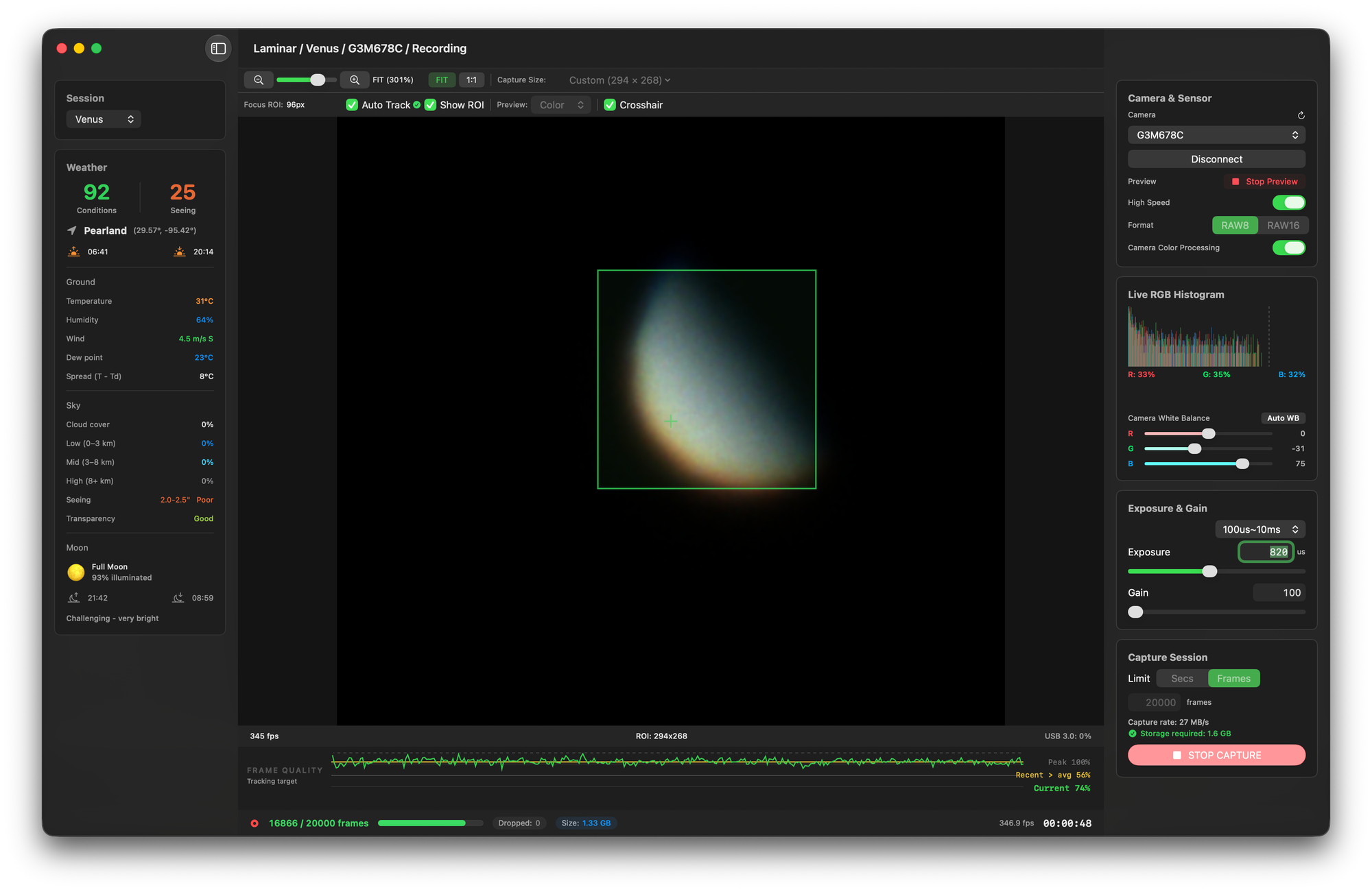
Here's a measurement from my own front driveway in July. Venus, ToupTek G3M678C, which uses the same Sony IMX678 sensor and the same 2.0 µm pixels as the ASI678MC discussed above. Telescope was a Celestron EdgeHD 8 at native f/10, 2,032 mm. Seeing that night was 2.0 to 2.5 arcsec, rated Poor, with a 93% illuminated Moon in the sky. Not a good night. A realistic one.
At f/10 with 2.0 µm pixels I'm sampling at 0.20 arcsec per pixel, running 820 microseconds at gain 100 in RAW8, on a 294 x 268 crop. That gave me 345 frames per second.
Then I put a 2.5x Tele Vue Powermate in the train. Focal length goes to 5,080 mm, the f-ratio goes to f/25, and pixel scale drops to 0.08 arcsec per pixel. Better sampling, in theory.
Light per pixel falls with the square of the f-ratio. Going from f/10 to f/25 costs a factor of 6.25, so my 820 microsecond exposure had to become 5.33 milliseconds. And the moment your exposure is 5.33 ms, your frame rate cannot exceed 188 fps no matter how hard you crop, because that's simply one divided by the exposure time. I measured 171.
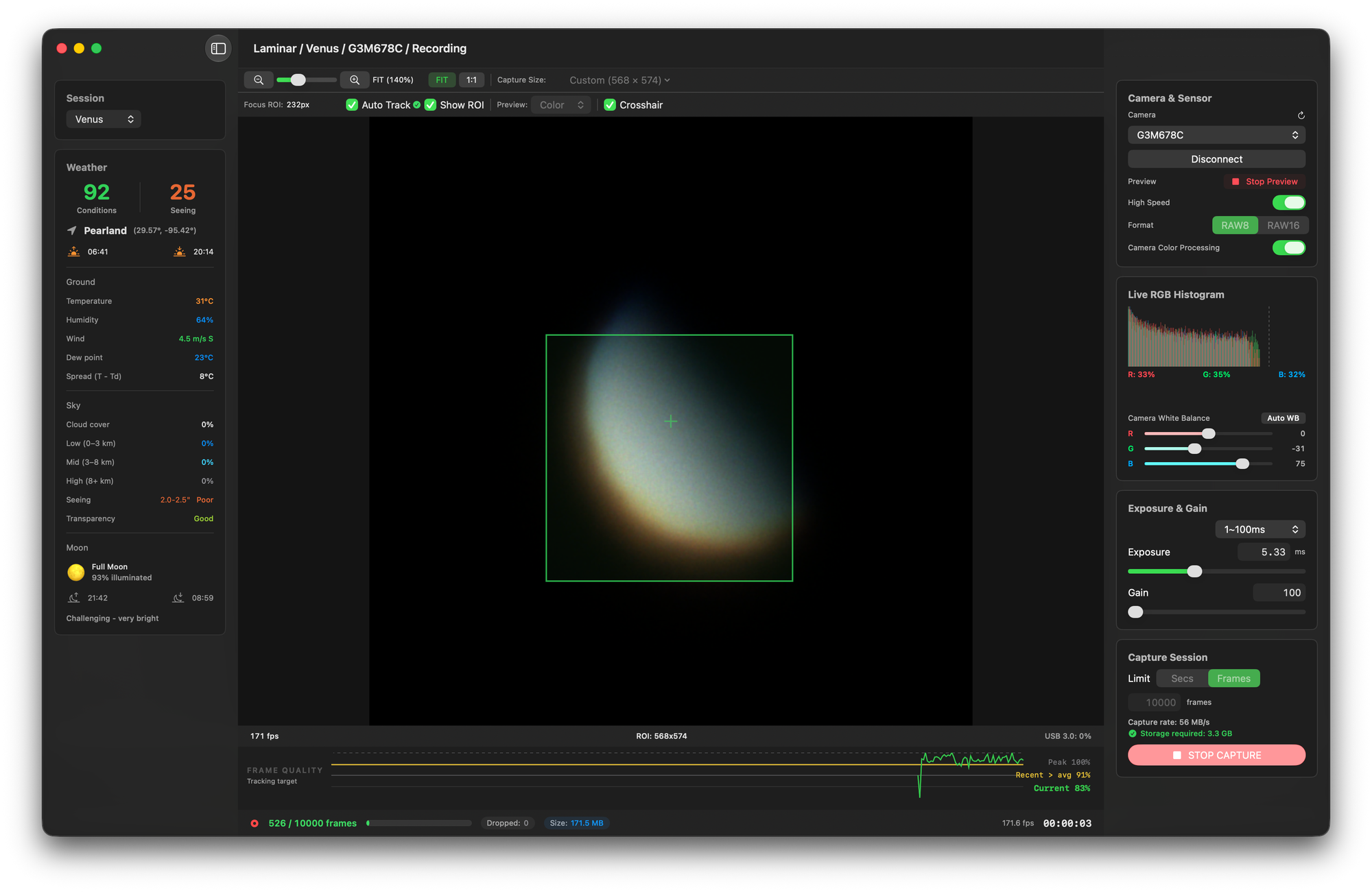
So I paid a little over half my frame rate to sample at 0.08 arcsec per pixel. An 8 inch aperture resolves about 0.68 arcsec at best, so at f/25 I was spreading the finest detail the telescope can deliver across eight pixels when three is plenty for a color sensor. That's roughly two and a half times more magnification than the optics could justify, bought with the one currency this article has spent three sections arguing matters most. The seeing made it worse but it wasn't the cause. The cause was reaching past what the aperture could resolve.
Amplification is worth reaching for when you're short of the target and the air is steady. Past that point it takes away more than it gives.
Both of those captures ran with zero dropped frames, the f/25 one sustaining 56 MB/s to 2.24 gigabytes. More on why that's worth watching further down.
So can the ASI533MC actually do planetary?
Yes, with caveats.
With ROI mode it produces competitive results, particularly on Jupiter and Saturn. Discussion on Cloudy Nights lands in roughly the same place: many DSO cameras can do decent planetary work through a region of interest, and the 533MC Pro comes up repeatedly as the example. Going the other direction, using a small uncooled planetary camera for serious deep-sky imaging, is the harder sell.
What the 533 won't do is close the gap when conditions turn against you. When seeing is genuinely bad, frame count is your only buffer, and 117 fps selects from a smaller pool than a dedicated camera does at the same crop.
The asymmetry is worth naming. A DSO camera pressed into planetary service is an imperfect but workable compromise. A planetary camera pressed into deep-sky service gives up cooling, field of view, and full well depth all at once. That's a bigger sacrifice.
- 3.76 µm pixels, 9 MP
- 1 inch square sensor, 11.31 x 11.31 mm
- 20 fps at full resolution, 14-bit
- 117 fps at a 640 x 480 crop
- Two-stage cooling for long exposures
- Read noise 3.8e at low gain, 1.0e at high
- 50 Ke full well
- Planetary: capable with ROI, not class-leading
- 2.0 µm pixels, 8.29 MP
- 1/1.8 inch sensor, 7.7 x 4.3 mm
- 47.5 fps at full resolution, 12-bit
- Cropping still required for high frame rates
- No cooling, short exposures don't need it
- Read noise as low as 0.6e
- 11.27 Ke full well
- Deep-sky: poor choice for wide field work
The middle ground
The ZWO ASI585MC sits between the two categories on purpose. It uses the Sony IMX585 with STARVIS 2, a 1/1.2 inch sensor measuring 11.14 x 6.26 mm, 3840 x 2160 at 2.9 µm pixels, 46.9 fps at full resolution in 12-bit mode, and zero amp glow. There's a cooled variant, the ASI585MC Pro, for extended deep-sky sessions.
Worth being precise about what it does and doesn't give you. Its 2.9 µm pixels are the same size as the ASI662MC's, so on the pixel scale question it's genuinely planetary-class. Its sensor area is about 70 square millimeters against the 533's 128, so on deep-sky field of view the 533 is the larger chip by a comfortable margin, despite the 585 having more pixels. Calling the 585 a wide-field camera would overstate it.
What you're buying is one body that does both jobs adequately rather than either one exceptionally. At $399 for the uncooled version, against roughly $800 for a 533MC Pro plus a dedicated planetary camera, that's a real argument for a first camera.
What Mac users need to know before buying
This is where the hardware conversation turns Mac-specific, and it's the dimension Windows-centric reviews skip entirely.
If you're coming from Windows, the first thing you'll go looking for is SharpCap for Mac. It doesn't exist. SharpCap is the default planetary capture application on Windows, and its own FAQ answers this the same way every time it comes up: Windows only, with no plans for other operating systems. If you're expecting to replicate that workflow on a Mac, you need a different plan.
The processing side is the same story. The standard Windows chain runs PIPP to condition the video, AutoStakkert to stack, RegiStax for wavelets, and WinJUPOS for derotation. Running AutoStakkert on Mac means Wine or CrossOver, because the app is Windows only and its developer states there are no plans for a native build.
Here's what actually works on a Mac.
Laminar is our own native capture app, and it's what produced both screenshots above. It talks to ZWO ASI cameras through the vendor SDK directly, along with PlayerOne, QHY, ToupTek and its OEM brands, and SVBONY, so nothing in this article locks you to one manufacturer. It records SER in RAW8 or RAW16 with frame or duration limits. For the question this article asks, three things matter: the ROI overlay sits on the live viewport so you can pull the crop in around the disk and watch the frame rate respond before committing anything to disk, live frame quality and focus tracking tell you whether the session is worth continuing, and the log-scaled histogram is there for setting exposure and gain. Requires macOS 14.6 or later and Apple Silicon.
ZWO ASIStudio bundles ASICap, ZWO's own capture tool, and there's a macOS build. If you're staying inside the ZWO ecosystem it's the lowest-friction starting point.
FireCapture, from Torsten Edelmann, is free, cross-platform, and has a macOS version. It's capable once running, though Mac users regularly report Gatekeeper friction on first launch.
AstroDMx Capture is worth knowing about as a cross-platform alternative if FireCapture's install gives you trouble.
Strata is our processing app, and it collapses that four-tool Windows chain into one: import, analyze, stack, derotate, sharpen, color, export. It takes SER from any capture tool and reads the uncompressed RAW8 AVI that ASIStudio writes, so neither route above strands you. All the pixel processing is deterministic GPU compute with no generative models anywhere in the pipeline. macOS 14.6 or later, tuned for Apple Silicon, Intel supported.
The part where software becomes a hardware constraint
A camera rated for high frame rates only delivers them if the software can receive and write frames at that speed, and the usual failure point is the disk rather than the camera.
That f/25 capture up above sustained 56 MB/s to 2.24 gigabytes with a dropped frame count of zero. Laminar counts drops strictly and measures each drive's real sustained write speed, states the measurement, and names the volume, so a capture quietly bleeding frames shows up as a number during the session instead of a disappointing stack the next morning. It also warns before recording if the capture folder has gone missing or ended up in the Trash, which is a more common way to lose a night than anyone admits.
On the processing side, the rejection percentages this article opened with are a real step rather than a figure of speech. Strata scores every frame on the GPU during its Analyze phase and hands you an interactive selection curve, so "keep the best 20%" becomes something you drag and see. When you're working from a smaller frame pool, being able to move that threshold and compare results matters more than picking a number and hoping.
Two more things map directly onto problems raised earlier. Jupiter's rotation caps a single capture at minutes before features smear, and Strata's Derotate phase combines multiple captures back into one result, with a separate path for Saturn's rings. And on the pixel scale question, drizzle at 1.5x, 2x, and 3x recovers some of what larger pixels give away, provided your frame count is high and your sampling is varied enough to support it. It won't turn 3.76 µm pixels into 2.0 µm pixels, but on a 533 at long focal length it's a real part of the answer.
When does a dedicated planetary camera actually pay off?
This is the question you came here with, so let me be direct.
Don't buy one yet if you already own a DSO camera with usable ROI, if planets are a secondary pursuit, or if you're in your first year and still building the workflow. Try what you have first. The results will tell you more than any spec comparison, this one included.
Buy one if planetary is your primary pursuit, if you image regularly from a site with mediocre seeing where frame count is the only lever you control, or if you're chasing fine detail on Jupiter and need every frame you can get inside the rotation window.
Consider the ASI585MC Pro if you're buying your first camera and want one body for both jobs. It's a trade rather than a compromise that disqualifies it from either discipline.
One thing that gets lost in camera comparisons: the telescope matters more than the camera. A dedicated planetary camera on a 480 mm refractor won't outperform a 533MC on a 2,800 mm SCT. Focal length is what puts planetary detail within reach of any camera's pixel scale. If you're considering camera upgrades before maximizing focal length, reconsider the order. The Celestron EdgeHD 11 sits at that intersection, and the Celestron EdgeHD 8 produced the measurements above. Just remember what the driveway test showed: focal length charges frame rate quadratically, and there's a point past which the aperture stops paying you back.
The entry-level dedicated planetary camera isn't a big financial commitment either. The ZWO ASI662MC runs $149 at Agena, and ZWO now recommends it as the replacement for the discontinued ASI462MC. If you've worked through ROI on your existing camera and you're hitting its ceiling, that's a straightforward upgrade with a clear payoff.
Can I use a deep-sky camera for planetary imaging?
What is pixel scale, and how do I calculate it?
Is there a version of SharpCap for Mac?
Does a Barlow or Powermate improve planetary results?