
EdgeHD focus data: 694 autofocus runs, one temperature coefficient, and a probe that lied for 23 nights
About two hours, and it barely matters whether the telescope started warm. My Celestron EdgeHD 11 lives in a roll-off roof observatory in the New Mexico desert, already sitting at outside temperature when the roof opens at dusk, and focus still drifts for another 90 to 120 minutes after that. It cools past the surrounding air rather than settling down to it, which is the opposite of what happens when you carry a scope out of a warm house.
That comes out of 694 autofocus runs recorded between February 15 and May 23, 2026, along with a number nobody seems to have published for this telescope: the EdgeHD 11 moves 37 focuser steps per degree Celsius. If you have been guessing at a temperature compensation coefficient for an Edge, that is the measured one.
And one more, which turned out to be the most useful of the three. My temperature probe froze solid on 23 separate nights and I had no idea. A third of the season ran with compensation silently doing nothing at all.
One telescope, one site, measured carefully. The numbers are from an 11, but the mechanism applies to every EdgeHD and the method applies to any telescope you can pull focus logs out of.
Why an EdgeHD needs a second focuser in the first place
Celestron does not hide from this one, which surprised me. Their own knowledge base says mirror flop is "seen especially in SCTs with apertures 11 in and larger," and it lists two remedies: the mirror locks, and an aftermarket zero-image-shift focuser. My setup is not a workaround the forums invented. It is what the manufacturer recommends.
The cause is structural. An SCT focuses by sliding the primary mirror along the baffle tube, driven by an arm on one side. A mirror on a sliding collar with a one-sided actuator shifts laterally when you focus, and settles to a new gravitational position as the tube tracks. Two different problems, one name. The first ruins your focus run. The second ruins your night, usually right after a meridian flip.
The mirror support clutches are the manufacturer's answer, and Celestron is careful about how it describes them. With enough tension they are "effective greatly lessening mirror shift or mirror flop." Greatly lessening. Not eliminating. On Cloudy Nights, freestar8n describes the clutches as pinchers on thin cables that still allow some float, which matches Celestron's hedge more closely than the confident advice you usually see.
So you lock the primary, take the built-in focuser out of the equation entirely, and put a Crayford on the back. hyiger on Cloudy Nights puts the workflow plainly: "The mirror locks are only useful for imaging if you have a Crayford focuser on the back end." The order matters, because as Linwood points out in the same thread, the mirror moves a little when you tighten the locks. Lock first, then find focus externally. Do it the other way round and you will lock in an error.
"The mirror locks are only useful for imaging if you have a Crayford focuser on the back end."
hyiger, Cloudy Nights
"When you lock them the mirror moves a bit, so you cannot really focus and then lock anyway."
Linwood, Cloudy Nights
"I use the MoonLite Revised CHL 2.5 inch and it works very well. There is no mirror flop or shift to contend with."
tjz, Cloudy Nights
Asked whether locking the mirror removes shift completely: "Not completely, but I find it adequate."
Endymion, Cloudy Nights
A dissenting view worth keeping in mind: "I have edgehd11 and I don't use the locks at all. I focus with a stepper motor on the primary knob."
freestar8n, Cloudy Nights
The MoonLite is not the obvious purchase it looks like. The EdgeHD 11 gives you 146.05mm of back focus from the baffle tube lock ring, and the 0.7x reducer does not spend any of it: Celestron specifies the same 146.05mm behind the reducer, which is one of the quietly good decisions in the Edge system. What that budget will not survive is a focuser that stacks behind the reducer, which is exactly what the standard MoonLite SCT model does. That is the entire reason the Edge variant exists as a separate product: its draw tube travels over the reducer instead, and MoonLite's own dealer guidance sends Edge owners to the thin CHL 2.5 model rather than the standard SCT one. On Cloudy Nights, gundark measured the CHL Edge as consuming about 33mm from the rear of the reducer, which on an 11 leaves roughly 113mm for the camera, filter wheel and off-axis guider. EdgeHD 8 owners have the tighter version of this problem: the reducer for that scope specifies 105mm, so the same 33mm focuser leaves about 72mm, and several report finishing their spacing arithmetic with 6mm to spare.
One thing worth knowing before you order: MoonLite stopped making manual focusers entirely, and their site is focuser.com, not the moonlitetelescope.com address you will find in older forum posts. That domain no longer resolves.
Budget some patience for the ordering itself. I design interfaces for a living, and the MoonLite configurator is pricing logic left to the page rather than explained to the buyer: the focuser body lists at $0.00 until you pick a motor, so the running total tells you nothing until the last dropdown. Mine came to $635 as an 11"/14" Edge flange, high-res stepper motor standalone, MoonLite Red, M54 68mm recessed T-thread adapter. Take the standalone motor if a Powerbox will drive it, since it arrives without a hand controller you would never use.
- Made for: Celestron EdgeHD 8", 9.25", 11" and 14" (one shared variant covers the 11 and 14)
- Why the Edge version: the draw tube travels over the 0.7x reducer, consuming roughly 33mm of back focus instead of the whole budget
- Travel: about 13mm (0.5"), measured by users. Short by design, enough for autofocus and thermal tracking, not a general purpose focuser
- Back focus available: 146.05mm on an EdgeHD 11 from the baffle tube lock ring, and unchanged with the 0.7x reducer fitted, which is Celestron's design intent rather than a happy accident (the 8" reducer specifies 105mm)
- Motorisation: motorised only. MoonLite no longer manufactures manual focusers
- Controller options: MoonLite MTS-1000 DRO, MTS-500-V2 Mini, or a third party focus controller such as the Pegasus Ultimate Powerbox
- Price as reviewed: $635 USD, configured as 11"/14" Edge flange, high-res stepper motor standalone, MoonLite Red, M54 68mm recessed T-thread adapter
- Note on the configurator: the focuser body shows $0.00 until a motor is selected, so the running total is not meaningful until the last dropdown is set
- Manufacturer: MoonLite Telescope Accessories, built to order
The rig, and the months it spent fighting itself
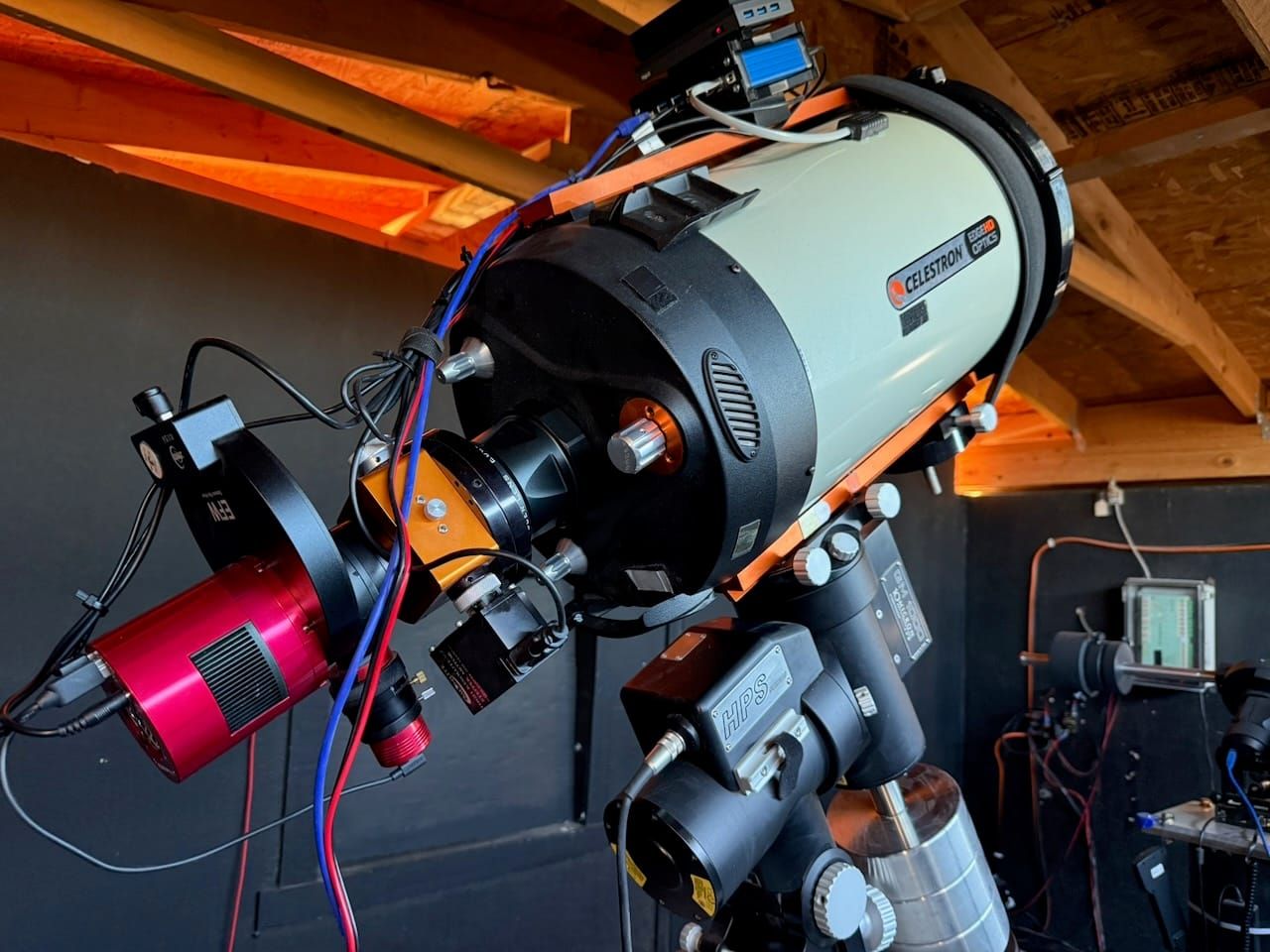
The telescope sits on a 10Micron GM1000 at Deep Space Products Remote in Animas, New Mexico. Bortle 1, high desert, and a roof that opens onto sky so dry and cold it will pull heat out of anything you point at it. Focus is a MoonLite CHL Edge with a stepper motor, driven by the focus controller built into a Pegasus Astro Ultimate Powerbox V2. Sequencing and autofocus run on N.I.N.A., which is simply the capture software I use. Nothing that follows depends on that choice: any package that logs a temperature and a fitted focus position for every autofocus run will give you the same numbers off your own telescope.
Then the hardware went to war with itself, and it took months to work out why.
It started with cables. They kept getting pinched in the gap between the focuser draw tube and the visual back. I got them unstuck, and found the real problem: rack the focuser in far enough and the off-axis guider collides with the focuser housing. It had been happening long enough to bend the OAG about seven degrees off axis. That is not a subtle amount. Guiding had been unexplainable for weeks and now I knew why.
I ordered a replacement, and Chris, the on-site tech at DSP Remote, fitted it. Which introduced a second collision. The angle the new OAG went on at put the focus motor itself into the MoonLite housing. Chris eventually unbolted the entire imaging train and re-oriented the motor so it cleared every housing surface, and that is what actually fixed it.
The autofocus logs recorded all of it, and this is the part I did not expect. When the motor or the OAG was jammed against something, the motor kept commanding steps, trying to reach a focus position it physically could not reach, and the position counter kept climbing. Focus sat near 7,300 steps through early March. After the cable and OAG work it jumped to about 12,600. Then between March 23 and April 3 it ran away completely: 13,620, then 15,065, then 18,338, then 23,434, then 25,674. Five sessions, twelve thousand steps, no actual focus movement to show for it. After Chris re-oriented the train on April 7 it settled at 27,500 and stayed there.
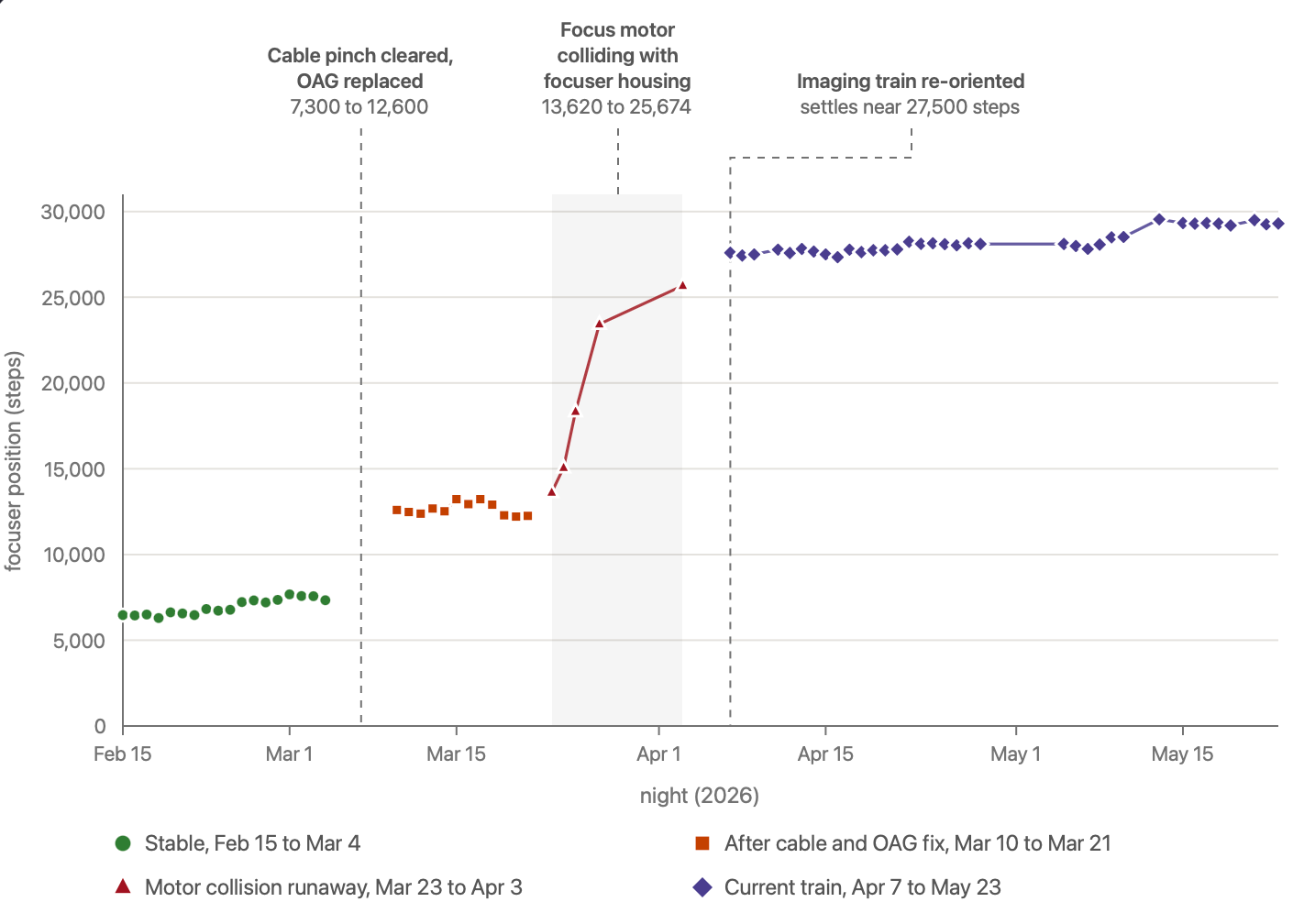
Here is the lesson that came out of that, and it is the reason the rest of this analysis works at all. After a stepper stalls against a hard stop, the absolute position number is fiction. The controller counts steps it commanded, not steps the motor turned. My focuser reads 27,500 today for the same optical configuration that read 7,300 in February. Nothing about the optics changed by 20,000 steps. The counter just drifted away from physical reality every time something jammed.
Which means any tool that fits a single line across that whole history is fitting noise. The plotting plugin I was using reported temperature coefficients anywhere from 50 to 877 steps per degree depending on the window, and every one of those numbers was garbage, because it was measuring my mechanical failures and calling them thermal response.
The real coefficient, and how to get one
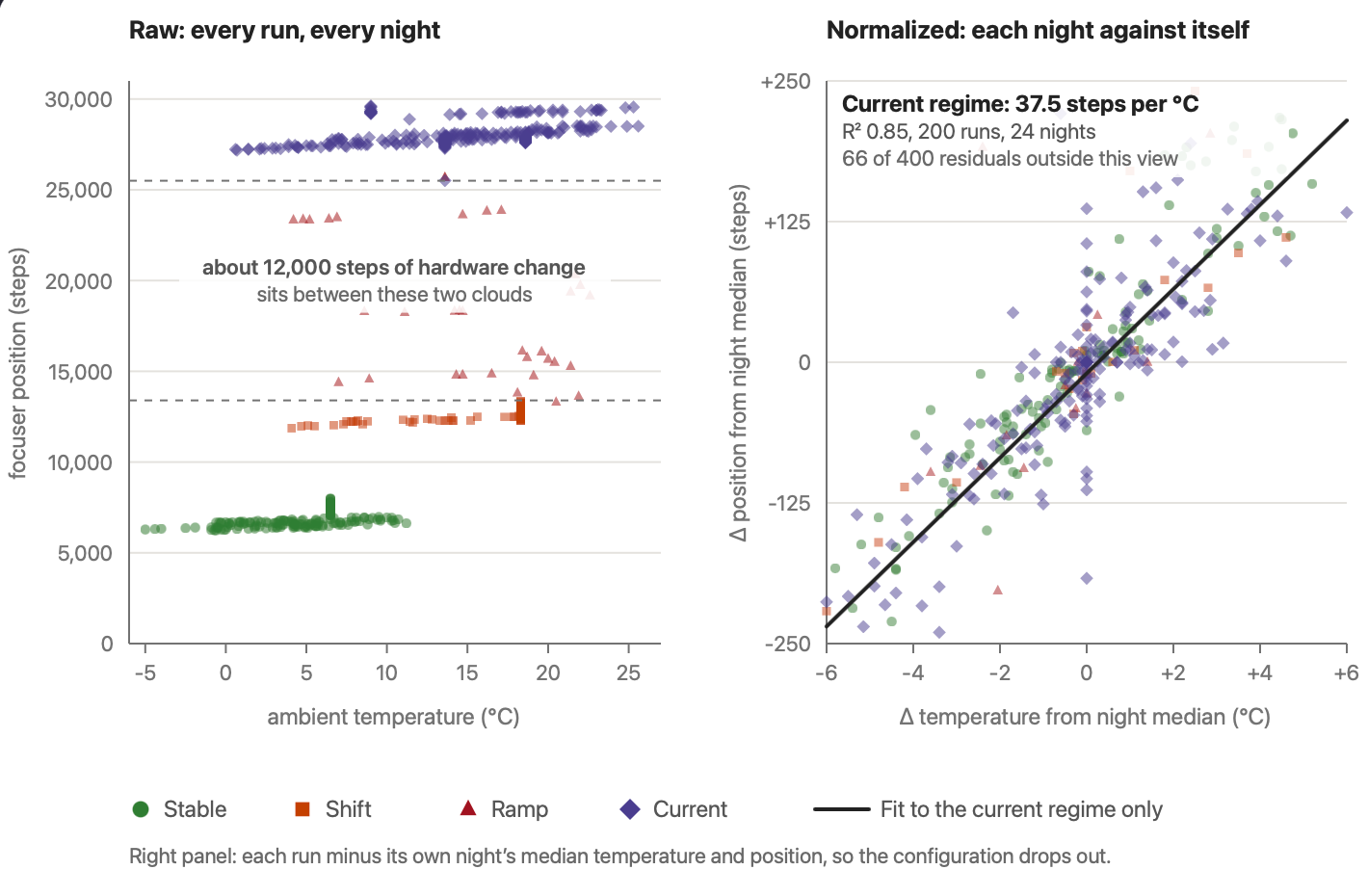
The fix is to stop looking at absolute position and start looking at what focus does within a single night. Subtract each night's median position and median temperature, and every good night collapses onto the same relationship regardless of where the counter happened to be sitting.
Do that, and the current configuration gives 37.5 steps per degree Celsius, R² 0.85, from 200 runs across 24 nights. Position rises as temperature rises. For a Pegasus focuser driver that works out to about 18 steps per half degree.
I want to be honest about the fit quality across the whole dataset, because it is not uniformly good. The earlier configuration comes out steeper, somewhere around 48 steps per degree, but with an R² of 0.72 and a lot of mechanical contamination underneath it. The runaway period fits at 77 steps per degree with an R² of 0.45, which is meaningless. Pooling everything gives 46.4 at R² 0.53. Use the current-rig number and throw the rest away.
Worth stressing that these are excellent autofocus runs. Median hyperbolic R² across the good set is 0.9994. The curve fits were never the problem. The mechanism was.
If you want to do this on your own rig, the method matters more than my number. Use one filter only, because filter thickness tolerances will contaminate the data. Collect across at least three or four degrees of swing. Normalize per night. And if the result is scatter rather than a line, astrojolo's guide on the subject is right that your setup simply cannot use temperature compensation reliably, and you should stop trying.

Cool-down in an observatory that never comes indoors
This is the section I would most like other EdgeHD owners to read, because the standard advice does not apply and following it will point you the wrong way.
The backyard story goes like this. Your scope lives at 70°F in the house. You carry it out into 45°F air. The glass and metal are warmer than ambient, they shed heat for an hour or two, and focus drifts as they do. Celestron's manual says allow 45 minutes between large temperature extremes, and Cloudy Nights reports for an EdgeHD 11 run from 20 to 150 minutes depending on the size of the jump.
My scope never comes indoors. It sits in a closed building at the ambient temperature of a New Mexico afternoon and the roof opens at dusk. By the backyard logic there should be nothing to wait for.
There is. And it runs the other way.
After removing the ambient response, focus carries an extra 35 to 50 steps of drift for the first 90 minutes or so, crossing into the autofocus noise band by about two hours and staying inside it after that. But the sign is negative. At the same measured temperature, best focus early in the night sits below where the probe predicts, not above. At 37 steps per degree that is about 1.2°C, and the optics are behaving as though they are colder than the air the sensor is reading.
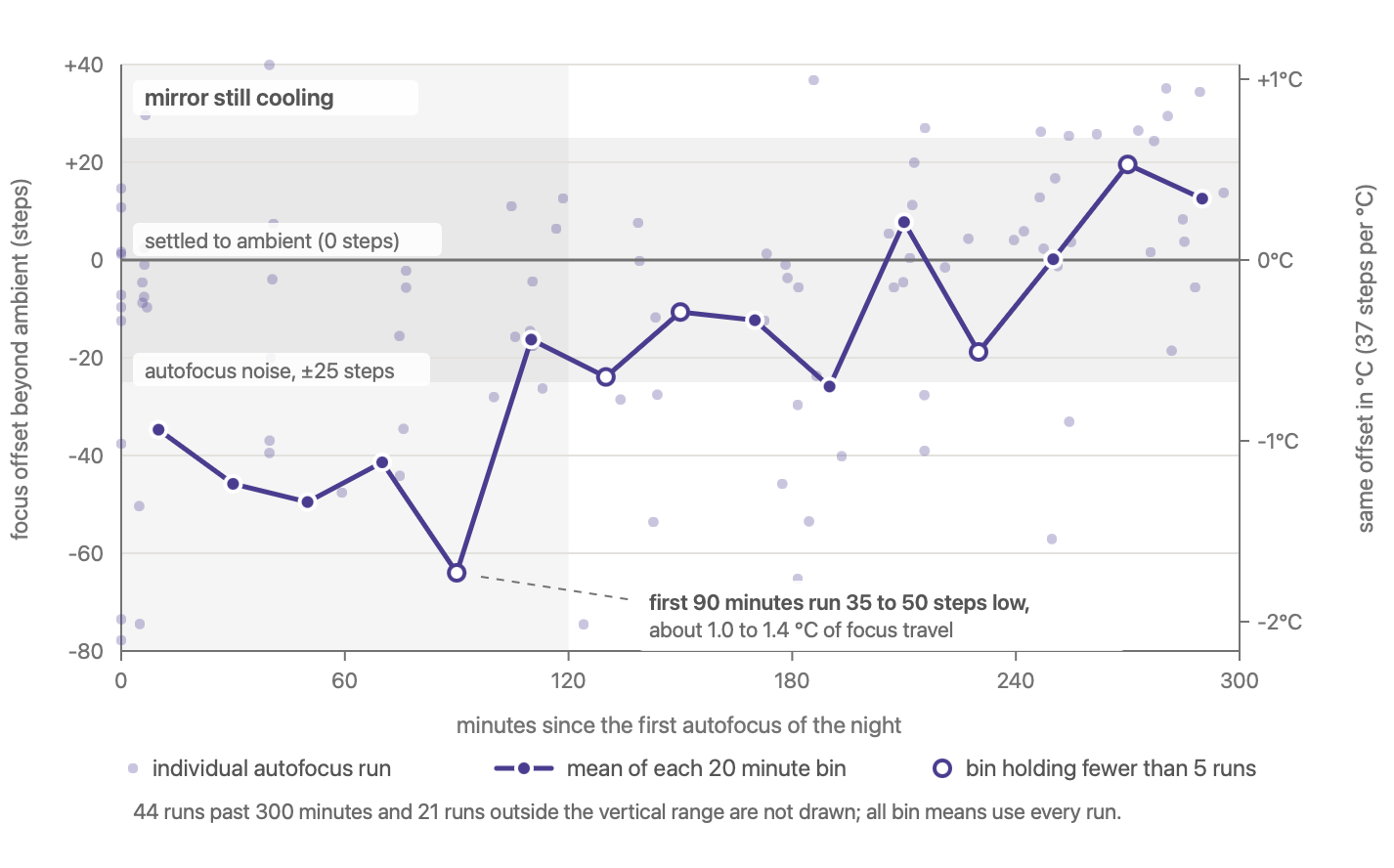
The explanation I find most convincing is radiative cooling. Open a roof onto a clear, dry desert sky and the effective sky temperature is tens of degrees below ambient. The corrector and the tube radiate straight into it and drop below the surrounding air. It is the same physics that frosts a corrector plate on a night that never reaches freezing. The mirror is not lagging behind a cooling air mass. It is outrunning it.
I should say clearly that I cannot fully separate that from the alternative, which is that my probe reads warm for the first couple of hours because of where it is mounted. The observable is the same either way, and so is the fix, but the mechanism is an inference and I would rather flag it than assert it. If somebody has run a mirror thermocouple against ambient on an EdgeHD in a dry site, I would like to see the data.
The practical consequence does not depend on which explanation is right. For the first two hours after roof-open, temperature compensation under-corrects. It is tracking the ambient slope correctly and missing an extra 45 steps of drift that has nothing to do with ambient. So autofocus roughly every 40 minutes early, relax to hourly once you are past the two-hour mark, and open the roof during twilight so most of the settling happens before the first useful sub.
The frozen probe, and how compensation fails without telling you
While working through this I found vertical stripes in the data. Nights where the logged temperature never changed, not by a tenth of a degree, while focus kept moving underneath it. Every run stamped with an identical value. They are visible in the left panel of the temperature chart above: the spike standing up out of the green cloud at 6.5°C and the one in the orange cloud at 18.3°C are not real behaviour, they are a sensor that stopped reporting.
I originally counted nine of these. Going back through the full season properly, there are 23 nights, covering 226 of 694 runs. A third of everything I recorded. Two long stretches I had completely missed: February 25 through March 3 stuck at 6.5°C for seven nights and 98 runs, and March 11 through 17 stuck at 18.3°C for another seven nights and 61 runs. The value only ever changed on a reconnect, which is the signature of a read-once-then-stale sensor rather than a broken one.
A frozen temperature probe produces no error and no warning. The only symptom is a logged temperature that never changes while focus keeps moving, which shows up as vertical stripes if you plot focus position against temperature.
To check: open your autofocus report folder (N.I.N.A. writes JSON reports to %LOCALAPPDATA%\NINA\AutoFocus\; other capture packages log the same fields elsewhere), pull the temperature value from every run on a given night, and count the distinct values. A clear night that reports one single temperature across eight or ten runs is a stale sensor, not a stable one. Genuine ambient in the high desert falls around 1.5 °C per hour.
The value typically only refreshes when the device reconnects, so a nightly disconnect and reconnect will mask the problem by making each night look plausible on its own.
Now here is why that is worse than it sounds, and it took reading a N.I.N.A. developer's forum post to see it.
The Ultimate Powerbox V2 has no temperature sensor of its own. Every reading comes from the external RJ12 environment probe, and an INDI bug report from 2020 confirms there are no temperature sensor signal lines on the focuser side at all. Meanwhile dghent, a N.I.N.A. developer, has stated that "NINA does not support using a non-focuser temperature source for determining focus changes."
On a UPBv2 the focuser and the environment probe are the same device. So that one small plastic probe is feeding the temperature compensation and the AF-after-temperature-change trigger and the dew heater logic. When it freezes, compensation quietly stops compensating, the temperature trigger stops triggering, and nothing anywhere logs an error. The sequence runs all night looking completely healthy.
For an unattended remote rig that is the failure mode I care about most, because there is nobody standing there to notice the number has not moved.
This is something Pegasus Astro should look at. A probe returning byte-identical readings for seven consecutive nights is a detectable condition, and detecting it is cheap. If the temperature has not moved by a tenth of a degree across an entire session while the focuser has moved hundreds of steps, the driver already has everything it needs to know something is wrong, and it could say so. As it stands the failure is indistinguishable from an unusually stable night. The V3 improves matters by adding a second sensor that can disagree with the first, but the real fix is software noticing a value that never changes.
What I would change
The V2 is discontinued now, replaced by the Ultimate Powerbox V3, and the single change that matters most for this problem is that the V3 has a temperature sensor built into the unit and prefers the external probe when one is present. Two sensors instead of one. My exact failure would have shown up as a disagreement between them rather than as nothing at all. If you are buying today and you run unattended, that alone justifies the newer box. Note that driving a MoonLite from either version needs the Pegasus RJ45-to-DB9 stepper cable, because every focuser manufacturer uses its own pinout.
I would also stop treating temperature compensation as the primary defense. N.I.N.A.'s documentation calls the time-based and exposure-count autofocus triggers "not recommended" and points at HFR-based triggering instead. Compensation has one advantage nothing else can match, which spokeshave identifies on Cloudy Nights: it corrects during an exposure, where an autofocus routine can only run between subs. On a night dropping 1.5°C per hour with long subs, that matters. But it is a supplement to measuring focus, not a replacement for it. Run compensation at 18 steps per half degree, and keep an HFR trigger underneath it as the thing that actually catches problems.
And I now check the probe reading in my logs on a schedule, because I ran a third of a season on a sensor that had stopped reporting and only found out because I went looking for something else.
Common questions about EdgeHD cool-down, focus drift, and temperature compensation.