
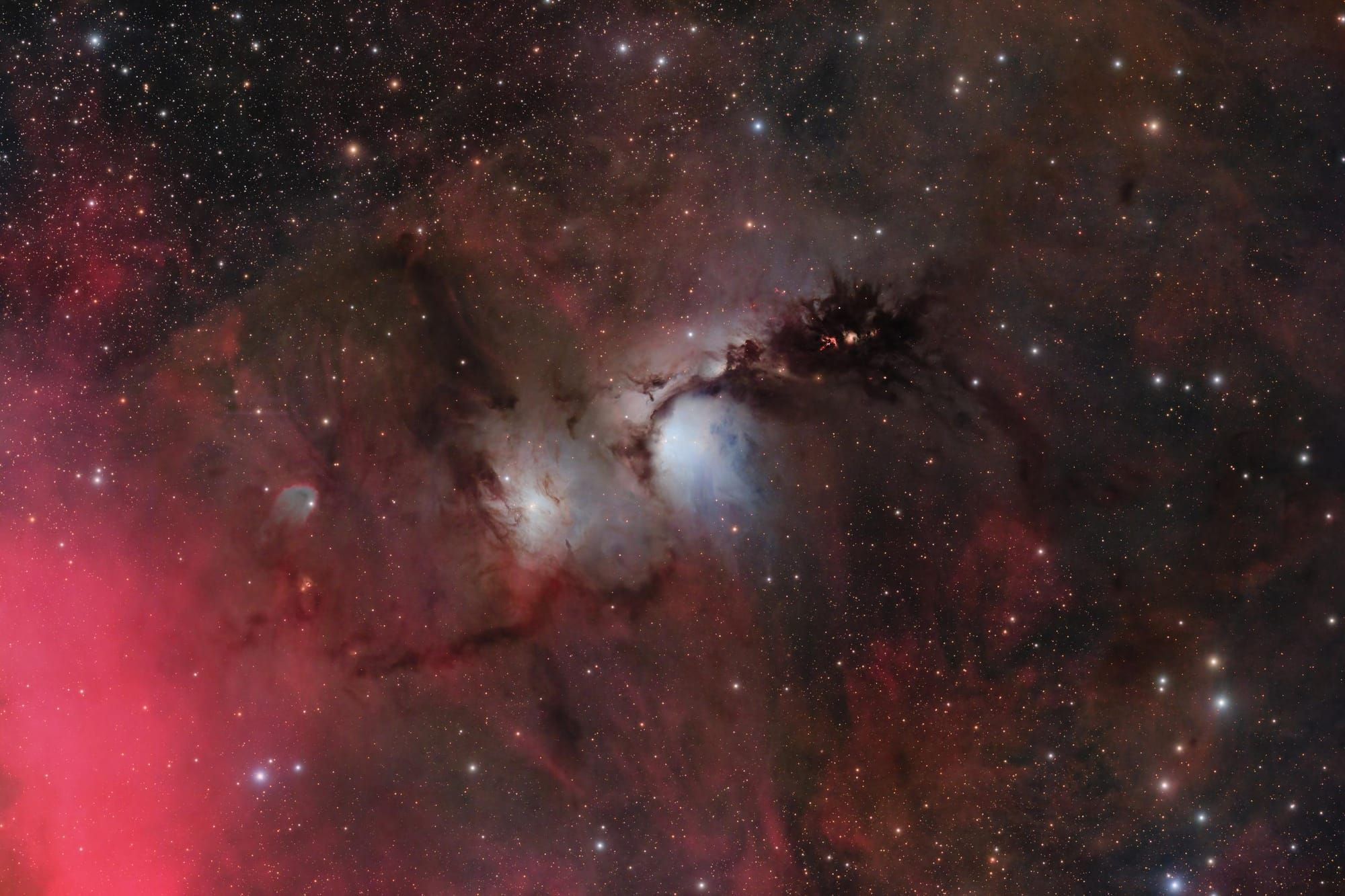
The survey ship Méchain dropped out of its final transit at the edge of Orion B in the spring of 3780, two thousand years after the man it was named for first saw the place. Pierre Méchain had been hunting comets from Paris, and in early 1780 he wrote down a faint patch on the left side of Orion: two fairly bright nuclei, surrounded by nebulosity. Charles Messier added it to his list that December as number seventy-eight. Neither man could have guessed what the patch was hiding.
From inside, the answer filled every screen. M78 is the brightest reflection nebula in the sky, a wall of dust some 1,600 light-years from Earth, lit blue by the two young stars Méchain had called nuclei. Behind the wall lay the dark cloud astronomers still called LDN 1630, and it was busy. The crew's infrared count passed one hundred and ninety newborn stars before lunch. Forty-five of them were still contracting, T Tauri stars flickering like nervous candles. Seventeen were firing jets of gas into the surrounding cloud, and where the jets struck, the gas glowed in small, bright knots.
Dr. Anjali Rao, who had spent her career on star formation, found that the most surprising thing was not the stars at all. It was the hydrogen. It hung everywhere, a faint red veil over the entire region, far brighter than the old survey pictures suggested. She dug through the archive and found a note left by an amateur astronomer on old Earth, attached to a 32-hour image made in 2023: he had added hydrogen-alpha data late in his run and had been startled to find it blanketing the whole frame. "He was right," she said quietly. "Nobody believed how much there was."
They stayed six months, mapped the jets, and cataloged a dozen young stars with planet-forming disks, any one of which might someday be somebody's sun. On the last night Rao wrote the closing entry in the ship's log. She tried several times to describe what they had seen, and deleted every attempt. In the end she simply typed what Méchain had written two thousand years before: two fairly bright nuclei, surrounded by nebulosity. Nobody had ever said it better.
Top Pick
32h 20m
Nov 1 to Nov 6, 2023 (5 nights)
Lum: 14h (84 × 600″)
Red: 4h 40m (28 × 600″)
Green: 4h 40m (28 × 600″)
Blue: 4h 40m (28 × 600″)
H-alpha: 4h 20m (26 × 600″)
Telescope: Takahashi TOA-130NFB
Camera: ZWO ASI6200MM Pro
Mount: 10Micron GM1000 HPS
Flattener: Takahashi 645 Flattener for TOA-130 (TKA31587S)
Focuser: Pegasus Astro FocusCube2
Filter Wheel: ZWO EFW 7 x 2″
Power: Pegasus Astro Powerbox Advance Gen2
Flat Panel: DeepSkyDad Flap Panel (FP1)
Chroma Lum 50 mm, Chroma Red 50 mm, Chroma Green 50 mm, Chroma Blue 50 mm, Chroma H-alpha 3nm Bandpass 50 mm
Aries Productions Astro Pixel Processor (APP), Pleiades Astrophoto PixInsight, Russell Croman Astrophotography BlurXTerminator, Russell Croman Astrophotography NoiseXTerminator, Russell Croman Astrophotography StarXTerminator
DSP Remote Observatory: Animas, NM: Bortle 1
View the full-resolution image and technical details on AstroBin.