

Meridian 1.1, my deep-sky imaging archive app for macOS, is out on the Mac App Store. It adds Skyshot, a blind plate solver that runs inside Meridian and solves a finished image in about half a second, with no account or internet connection. It also adds Annotations, which label the cataloged objects in a solved image at their real size and position. The update is free for existing owners.
Skyshot uses a star index that you download separately from skyshot.app. Meridian doesn't include it. Without the index, plate solving works the same as in 1.0.
- Meridian 1.1 from the Mac App Store, on macOS 14 or later.
- The Skyshot Full index, about 840 MB, from Skyshot's downloads page.
- Optional: the DEEP index, about 4 GB more, for narrow fields.
- In Meridian's Settings, under Plate Solver, choose the folder where you saved the index.
Why does an archive app need a plate solver?
Meridian identifies targets from the coordinates your capture software writes into each light frame. Finished images exported from PixInsight or Siril as JPEG or TIFF usually don't have coordinates. Neither do DSLR frames converted to FITS or some smart telescope files. To identify those, Meridian needs a plate solver.
Before 1.1, Meridian could solve them with ASTAP, which you install separately, or with Astrometry.net, which needs your own API key and uploads each file to an online queue. Both still work in 1.1. ASTAP works best with a starting position and pixel scale, which finished images usually don't have, and Astrometry.net is slow for large batches. If you're new to plate solving, my guide to identifying unknown objects in your deep-sky images explains the basics.
What is Skyshot?
Skyshot is a free, open-source blind plate solver by Adam Jesionkiewicz, written in Rust and released under the Apache 2.0 license. Given an image with no coordinates, focal length or pixel scale, it finds where the camera was pointing, the image scale, the rotation, and whether the image is mirrored. It runs on the CPU against a local index and doesn't need a network connection.
Blind solving is what Skyshot does best. In Adam's published test of 91 frames with all hints and metadata removed, it solved all 91, with a median time of about 30 milliseconds per frame on an M5 Max, including startup. It's far better at blind solving than ASTAP or any other solver I've used, and much faster.
Adam's website, skyshot.app, is worth a look. Its web app solves images in your browser: your browser detects the stars and sends only their positions to his server. The source code and his two research papers are on GitHub.
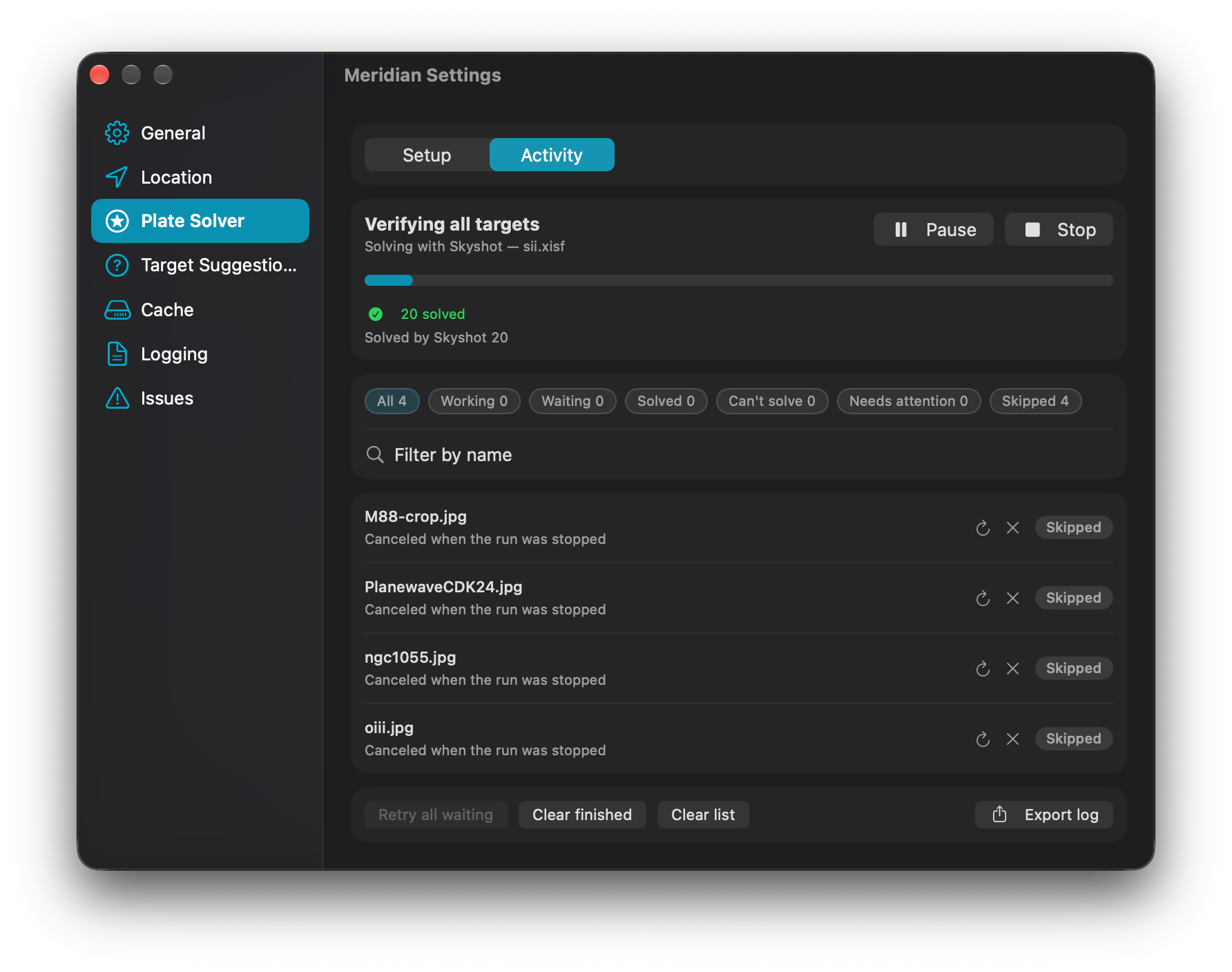
Skyshot is the first third-party library in Meridian. Until 1.1, Meridian used only Apple frameworks. Skyshot is compiled into the app, so the index is the only thing you need to install. Meridian doesn't include or download the index, because the index has its own terms of use, separate from the solver's license. Settings links to Skyshot's download page and those terms, and you choose the folder where you saved the index.
How fast is Skyshot in Meridian?
On my library, a 60-megapixel final on an external hard drive solves in about half a second, including the time to read the file. Adam's measurements put the solve itself at a few milliseconds, so most of that half second is probably reading the file and finding the stars.
At that rate, my roughly 1,100 finished images would take about ten minutes to solve.
Before adding Skyshot, I tested it on files with known answers. Six light frames gave identical results solved blind and with header hints. Of 21 finished images, 18 solved blind and matched the positions from their light frames.
How does Meridian check Skyshot's results?
Finished images go to Skyshot first. If the full-size image doesn't solve, Meridian tries again at half and quarter size and accepts the result only if two sizes give the same position. If that fails and you've turned on cloud rescue with your own Astrometry.net key, the image goes to Astrometry.net. Cloud rescue now runs up to three Astrometry.net jobs at a time and drops to one if the service slows down.
Light frames are solved with Skyshot only, using the pointing and scale from the header when the file has them. If Skyshot identifies a target Meridian couldn't, a second light frame from that target has to give the same result before Meridian renames it. With only one frame, Meridian shows a Target Suggestion instead.
When you run Solve Images with an index set, Skyshot also rechecks finals that were already solved. If the new result is within half a field of the stored one, it replaces it. If not, Meridian keeps the stored solution and lists both positions in Issues.
Each solution is stored with a record of the file it came from. If the file changes, Meridian stops using that solution. Plate solving never changes your files. Solutions are stored only in Meridian's catalog.
What do Annotations show?
On a solved finished image, Annotations draw a ring around each cataloged object in the frame, at the object's catalog size and position, with labels placed so they don't overlap. Click a ring or label to see the object's details, open it as a target, or add it to your Wish List. Annotations support keyboard navigation and VoiceOver.
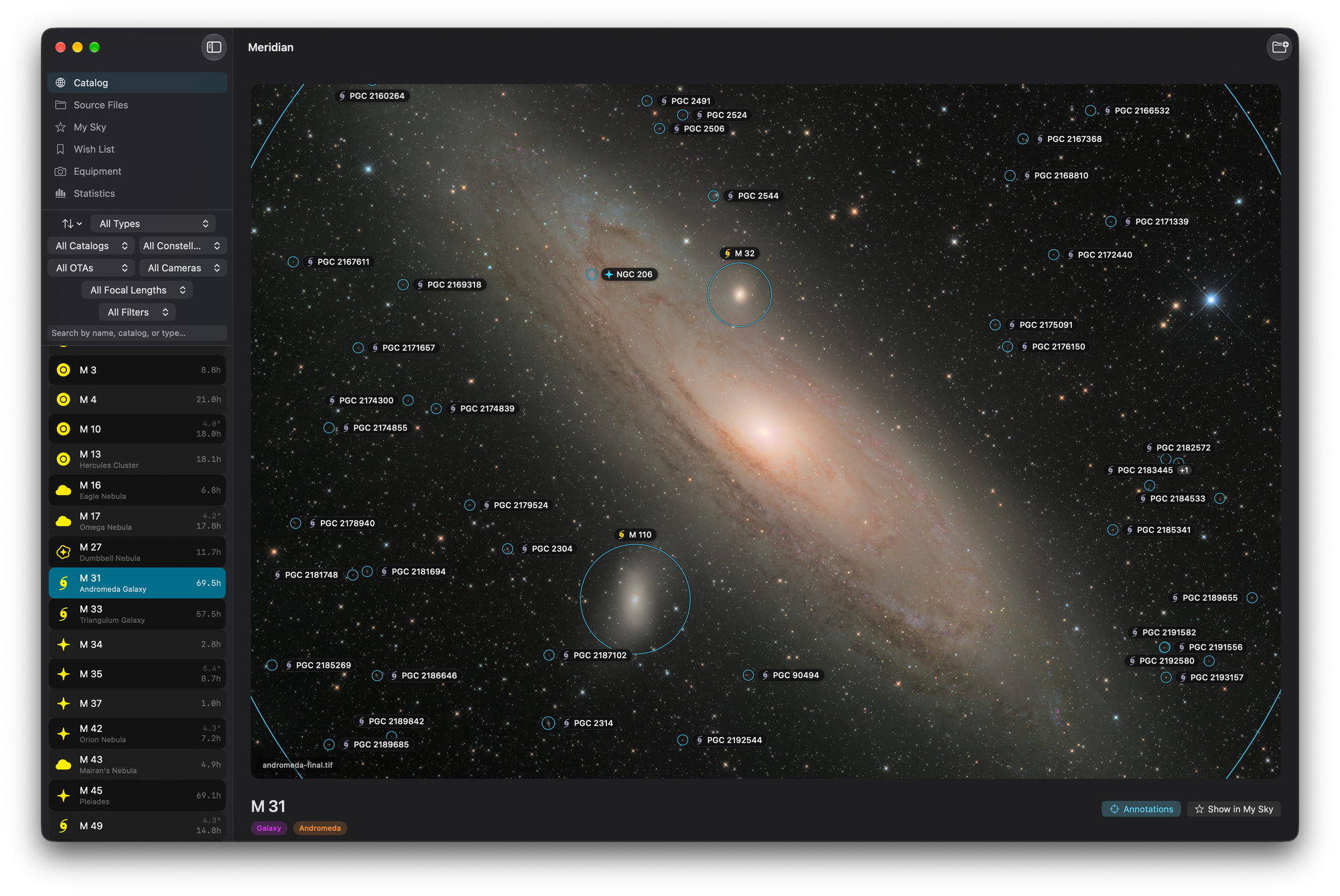
Annotations also label objects from catalogs that Meridian doesn't use to identify targets, including the Strasbourg-ESO catalogue of galactic planetary nebulae and Green's catalogue of supernova remnants. These labels never change a target's name.
What else changed in Meridian 1.1?
FITS and XISF files with 8-bit, 32-bit integer and 64-bit float data now get thumbnails, star analysis and plate solving.
The sky survey images in My Sky and the Wish List (DSS2 Color, 2MASS and AllWISE) now load from ESA's mirror when the CDS servers in Strasbourg can't be reached.
The Help book has new pages for Skyshot, Annotations, Quick Tips, Credits and Skyshot's licenses.
The first time Meridian 1.1 opens a library, it converts it to a new format. Meridian 1.0 can't open the library after that. If you use the same library on more than one Mac, update Meridian on all of them.
Limitations
The Skyshot Full index is about 840 MB. With the optional DEEP index, the total is close to 5 GB.
Annotations need the full solution that Skyshot stores. Finals solved only through Astrometry.net don't show Annotations.
Plate solving runs from Settings, not from the image you're viewing. Scanning a library never starts plate solving on its own.
Common questions about Skyshot and Annotations in Meridian 1.1.