
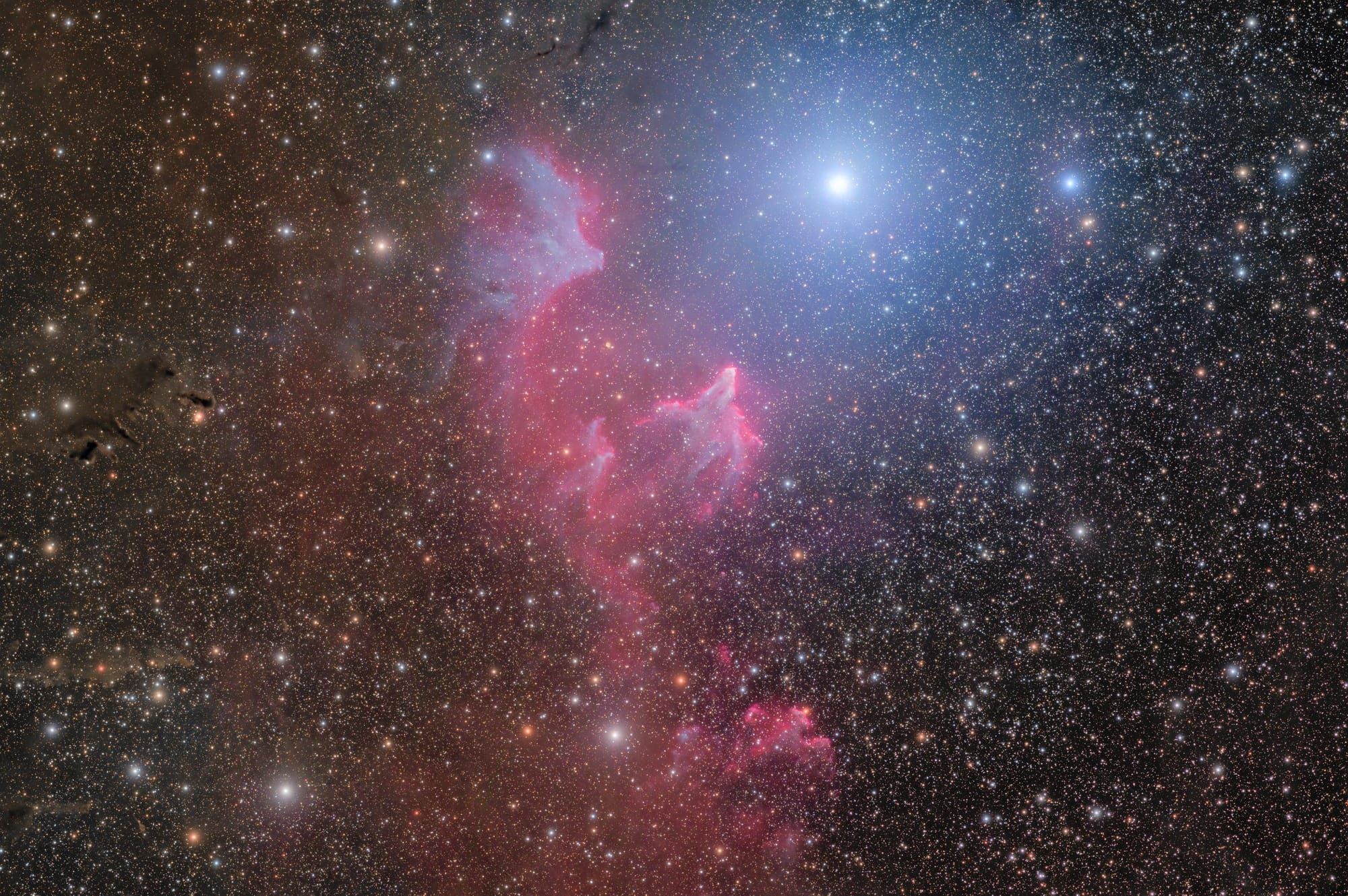
In the summer the Houston heat did not break until nearly midnight, and that was when Tom's grandfather would carry the folding chairs out to the yard and point north, past the refinery glow, to the crooked W of Cassiopeia. "The middle one," he'd say. "That's Navi. A friend of mine named it." Tom was nine and did not believe him, because stars were named by Greeks and Arabs who had been dead a thousand years, not by men who drank coffee from a thermos.
But the old man had worked the consoles at the space center in the sixties, and he told it plainly. The astronauts needed navigation stars, and a few of the ones they used had no names worth saying over a radio, so the crews gave them names of their own. Gus Grissom took his middle name, Ivan, and spelled it backward. Navi. Then the fire took Gus on the launch pad in January of 1967, before he ever went to the Moon, and the name stayed up there anyway, printed in the star charts like a note nobody could bring themselves to erase.
Years later Tom learned the rest from a telescope of his own. Navi is no quiet lantern. It is a hot blue star spinning so fast it throws a disk of gas from its own waist, brightening and fading on no schedule anyone has cracked, and pouring out X-rays that astronomers still argue about. About three light-years away hang two clouds, IC 63 and IC 59, and the star's ultraviolet light is slowly burning them away: one glows red where its hydrogen is struck, the other shines blue where its dust only reflects. Seen together they look like a ghost walking away from a fire.
On the night he finally captured it, Tom sat alone in the yard where the chairs used to be and watched the frames come in, nine hours of light that had left the star around the time Gutenberg was building his press. The ghost clouds were thinning, the astronomers said, and in a few million years there would be nothing left of them to see. Tom figured that was all right. Some things are meant to be worn away. Some names are meant to stay.
Image of the Day, October 3, 2023
9h
Sep 22, 2023
Lum: 4h 30m (27 × 600″)
Red: 1h 30m (9 × 600″)
Green: 1h 30m (9 × 600″)
Blue: 1h 30m (9 × 600″)
Telescope: Takahashi TOA-130NFB
Camera: ZWO ASI6200MM Pro
Mount: 10Micron GM1000 HPS
Flattener: Takahashi 645 Flattener for TOA-130 (TKA31587S)
Focuser: Pegasus Astro FocusCube2
Filter Wheel: ZWO EFW 7 x 2″
Power: Pegasus Astro Powerbox Advance Gen2
Flat Panel: DeepSkyDad Flap Panel (FP1)
Chroma Lum 50 mm, Chroma Red 50 mm, Chroma Green 50 mm, Chroma Blue 50 mm
Aries Productions Astro Pixel Processor (APP), Pleiades Astrophoto PixInsight, Russell Croman Astrophotography BlurXTerminator, Russell Croman Astrophotography NoiseXTerminator, Russell Croman Astrophotography StarXTerminator
DSP Remote Observatory: Animas, NM: Bortle 1
View the full-resolution image and technical details on AstroBin.