
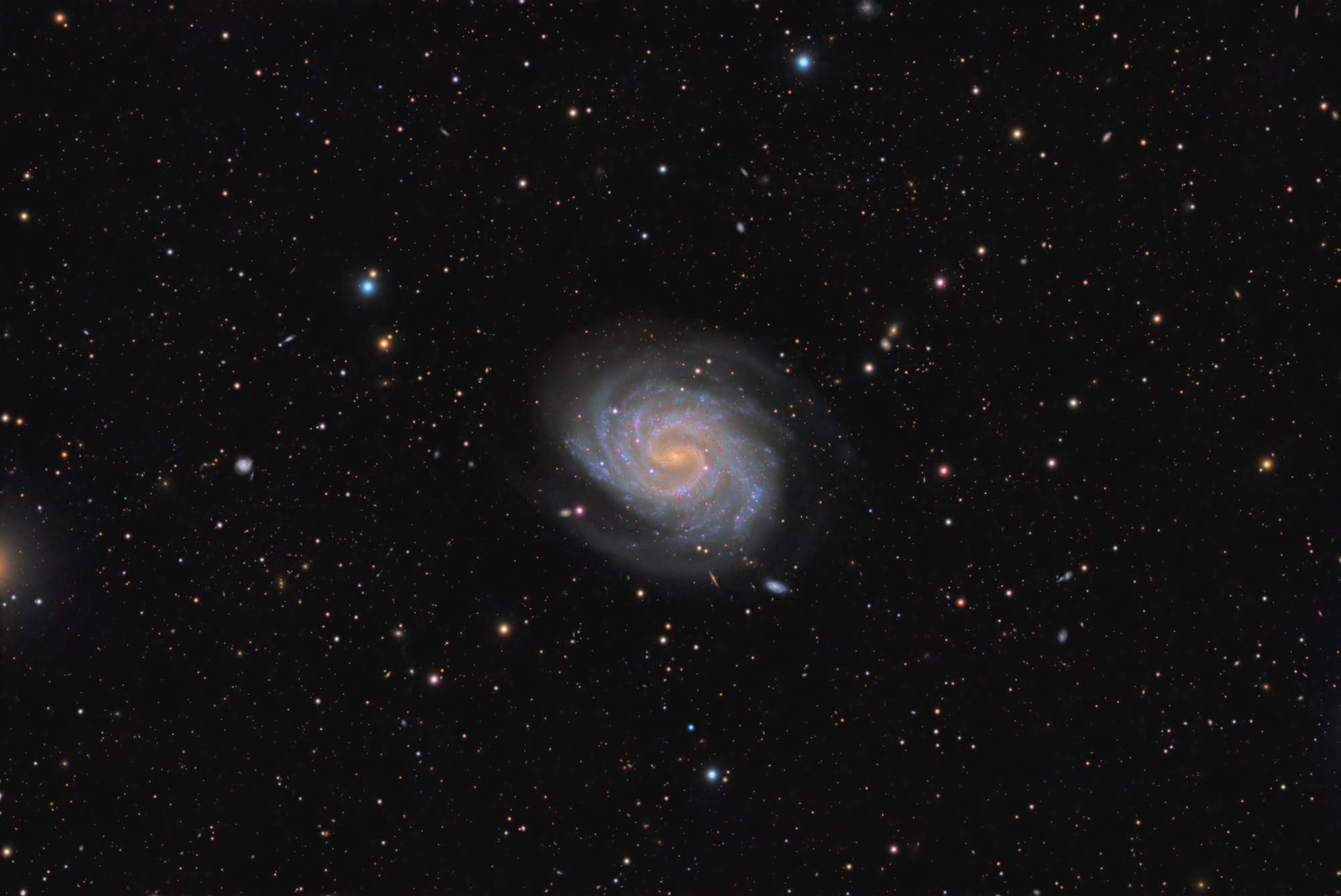
They called NGC 4535 the Lost Galaxy because it was hard to see, a pale barred spiral adrift in Virgo, dim in small telescopes and easy to overlook. That was the first mistake humanity made. The second was assuming that anything so ghostly must also be empty. For two centuries they admired its nearly face-on arms, measured its distance at roughly fifty million light-years, and congratulated themselves for noticing the blue star nurseries and old yellow heart glowing at its center, never imagining that the galaxy was looking back.
I was born in the bar, where the oldest cities circled the bulge like embers around a furnace. We learned our history differently from humans. They spoke of William Herschel discovering us in 1785. We taught our children that discovery means more than being seen. It means being understood. So while Earth named us, photographed us, and nicknamed us with patronizing affection, our astronomers listened to the Cepheid variables flickering through our arms like a code built into the bones of the universe. Fifty of them had been enough for human science to measure distance. For us, they were part of a metronome.
The pattern repeated nowhere else. Not in Andromeda. Not in Messier 87. Not even in the bright scatter of Virgo around us. Only in NGC 4535 did the Cepheids pulse with a timing that could not be natural when heard all at once. We built machines the size of moons to follow the rhythm down into the dust lanes, and there we found it: not a signal from outside, but a lock. Our whole galaxy had been shaped into a dormant transmitter, its bar the spine, its spiral arms the coils, its H II regions the charged nodes waiting for ignition. We were not living in a galaxy. We were living inside a message.
When we finally turned it on, every blue cluster in NGC 4535 flared in sequence, and the light crossed fifty million years toward the Milky Way. On Earth, astronomers first thought they had discovered a new phenomenon in the Lost Galaxy. Then they decoded the pulse. It was not mathematics. It was not a greeting. It was a receipt, stamped across intergalactic dark in precise human language, dated before Earth had life complex enough to crawl: DELIVERY CONFIRMED. MILKY WAY SUCCESSFULLY SEEDED.
31h 40m
Lum/Clear — 16h 40m (200 × 300″)
Red — 5h (60 × 300″)
Green — 5h (60 × 300″)
Blue — 5h (60 × 300″)
Telescope — Celestron EdgeHD 11″
Camera — ZWO ASI2600MC Pro
Mount — 10Micron GM1000 HPS
Reducer — Celestron 0.7X Reducer EdgeHD 1100
Focuser — MoonLite CSL 2.5″ Large Format Crayford SCT/RC
Filter Wheel — ZWO EFW 7 × 36mm
OAG — ZWO OAG-L
Power — Pegasus Astro Ultimate Powerbox 2
Flat Panel — DeepSkyDad Observatory Flat Panel (OFP2)
Pleiades Astrophoto PixInsight · Adobe Photoshop
Russell Croman — BlurXTerminator · NoiseXTerminator · StarXTerminator
DSP Remote Observatory · Animas, NM · Bortle 1
View the full-resolution image and technical details on AstroBin.